
Office cleaning
Why Vacuuming Leaves Grit Behind: Check the Brush and Carpet Match
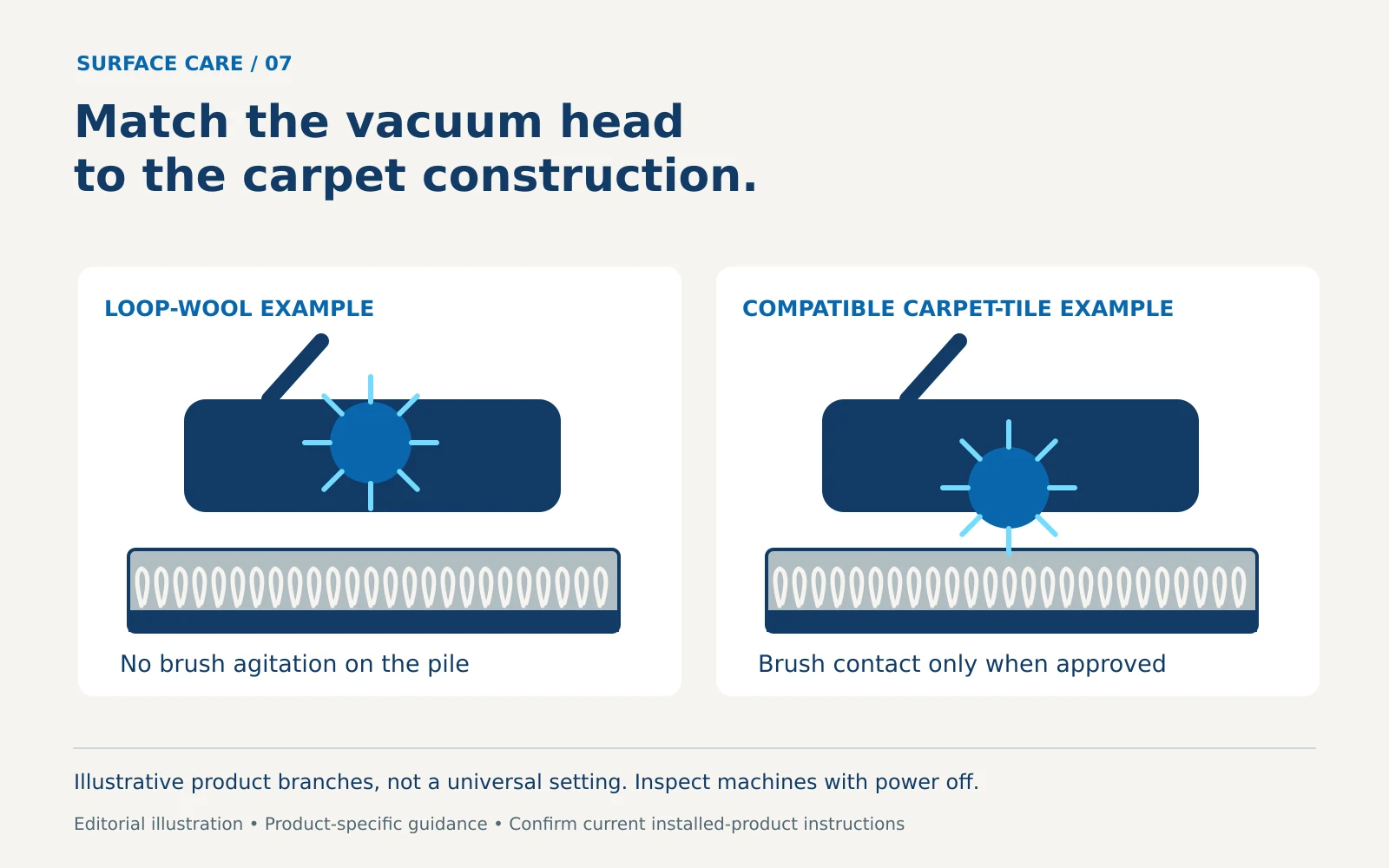
If ordinary grit remains after vacuuming, check the carpet's approved head type, the machine's condition and the technique before adding more passes. A powered brush can be appropriate for one installation and unsuitable for another. Lowering it as far as possible is not a reliable troubleshooting method.
Identify the carpet before changing the setting
Find the manufacturer and product record, then confirm fiber, loop or cut pile, and whether the carpet is installed over cushion or directly bonded. Request the care instructions if this information is missing. Do not identify wool by appearance or test an unknown carpet with progressively stronger brushing.
One office may contain several carpet products. Mark those changes on the cleaning plan, especially where a reception area transitions into corridors. A machine setting carried across that boundary can undermine an otherwise careful routine.
Resolve the brush question first
Shaw's Axminster and woven-wool checklist gives different advice for different constructions. For loop-pile wool or wool blends, it recommends strong suction without brush agitation, or an adjustable brush raised clear of the pile. For cut-pile wool over cushion, it allows a rotating brush or combination beater/brush; directly glued cut pile calls for a rotating brush rather than a beater bar. Its adjustment advice calls for useful contact without significantly slowing the motor. Follow those branches within the scope of that guide.
By comparison, Interface's carpet-tile instructions call for cylindrical-brush contact and slow, overlapping passes. That is product-specific advice, not permission to agitate an unrelated wool-loop installation.
If the carpet guide and machine manual cannot be reconciled, pause and ask the carpet manufacturer or equipment supplier. An attachment that fits the hose is not automatically appropriate for the floor.
Inspect the machine safely
Switch off and disconnect power as the equipment manual requires before examining a head, brush or obstruction. Do not reach into a running head to check rotation.
Use the model's maintenance instructions to check:
- Whether the bag or collection container needs attention
- Whether the air path or head is obstructed
- Whether an approved brush is fouled, worn or incorrectly installed
- Whether the belt, if fitted, needs replacement
- Whether the filter is correctly installed and serviceable
Do not wash a filter unless its manufacturer permits washing. The separate guide to cleaning a vacuum filter safely covers that decision.
After reassembly, use the manufacturer's normal operating checks. Stop for abnormal noise, a stalled brush, overheating or a damaged cord. Equipment faults need correction before another floor test.
Test a small ordinary-soil area
Choose an accessible section with ordinary dry grit and intact carpet. This check does not apply to sharp debris, a wet spill or unknown construction dust.
Record the machine, head and permitted setting. Make controlled passes using the approved technique, including the edges where relevant. The Carpet and Rug Institute emphasizes steady vacuuming and attention to corners; a fast pass across the center of the room is an incomplete comparison.
Inspect the result in consistent lighting. Has loose grit been collected? Are visible particles simply beyond the head's reach? Is there any new fuzzing, snagging or texture change? Stop immediately if the surface changes. Avoid grinding the head over a stubborn mark that may not be loose soil.
Change only one permitted variable at a time, such as correcting a documented height setting or replacing a full bag. That makes the next result informative. Randomly changing the head, technique and settings together makes the cause harder to establish.
A practical two-zone example
Suppose a corridor and a reception inset both retain grit. The corridor's identified carpet permits brush contact, while the reception inset has loop-wool instructions requiring suction without agitation.
The sensible test uses each zone's approved configuration. If pickup improves after correcting the corridor's setting, record that setting for the crew. If the reception area still retains grit with a maintained, compatible machine, seek product-specific help instead of lowering the brush onto the wool.
This is an illustrative troubleshooting sequence, not a diagnosis of every poor result. A clean-looking pass also does not measure indoor air quality.
Leave a repeatable instruction
Keep a short equipment record: carpet product, permitted head, setting, problem observed, corrective action and result. When there is no improvement, send that record to the responsible facilities contact or supplier. It is more useful than asking the crew to “vacuum harder.”
For an office or business cleaning quote in Orange County, Chino Hills, Chino, Ontario, Corona or Eastvale, contact JLV Cleaning & Maintenance with the area and carpet details. Confirm equipment compatibility within the agreed scope.