
Office cleaning
Why a Floor Scrubber Leaves Water Trails and What to Check First
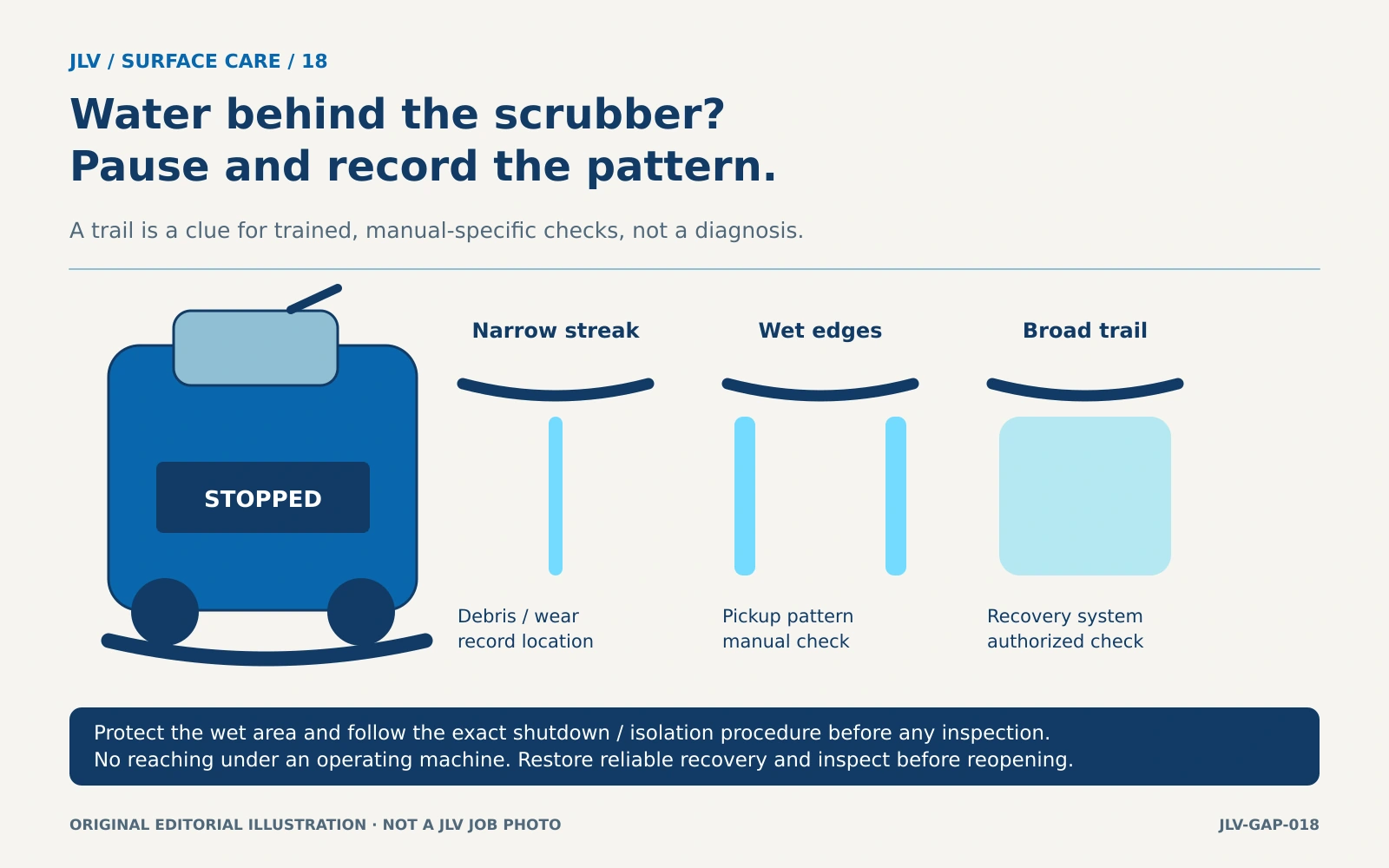
When a floor scrubber leaves a water trail, pause the cleaning run and protect the wet area. Repeated passes can spread the problem and make it harder to see whether the fault starts at the blade, the recovery system or the way the machine is being stopped.
A narrow streak, wet edges and broad trailing water are useful observations to record. They are clues for an operator's check, not enough to identify a failed part by themselves.
Make the machine and route safe first
Keep pedestrians out of the affected section and provide a usable alternative route. Arrange approved water recovery while the machine is assessed. Signs should support the access plan rather than substitute for it.
Find the exact manufacturer, model and operator manual. Before touching the squeegee or opening a maintenance access point, follow that manual's shutdown and isolation procedure. On the Tennant T360, instructions include stopping on a level surface, switching off and removing the key; repair and servicing precautions may require further isolation. Staff should perform only tasks covered by their training. Tennant T360 operator manual
Do not reach under an operating machine or ask someone to inspect a blade while another person drives it.
Start with a narrow streak
Tennant identifies debris along the squeegee edge as a common source of streaking. Its guidance calls for raising the assembly and wiping the blade length with a clean cloth. Apply that check only after the relevant safe-stop procedure, then inspect for visible wear or damage. Tennant squeegee guidance
Write down what was found. “Removed a strand at the right-hand blade edge” is more useful for the next operator than “machine cleaned.” If debris keeps returning, review the loose-soil preparation and the area being cleaned rather than assuming every repeat needs a new blade.
Use a short, controlled trial in the isolated area after an authorized correction. Watch whether the original streak returns in the same position. Do not resume a full corridor merely because the first few inches look better.
Check uneven pickup without guessing adjustments
Tennant notes that pickup failures at the center or edges can relate to blade pressure or angle. Its advice is to use the machine's operator manual for adjustments. Greater pressure is not automatically better. Tennant squeegee guidance
Record where the water remains, whether it happens on straight runs or turns, and whether the problem appeared after a blade change. Give that information to the trained operator or equipment contact. Avoid borrowing an adjustment measurement from another model, even if its squeegee looks similar.
Broaden the check when water keeps trailing
The T360's troubleshooting list includes a full recovery tank, excessive foam, worn blades, blocked components, vacuum-hose problems and recovery-lid sealing problems. These are model-specific checks, not a direction to dismantle any scrubber with a wet trail. Tennant T360 troubleshooting
For that model, the stopping sequence also includes continuing forward to collect remaining water before lifting the squeegee. A trail appearing only at the end of a run makes the approved operating sequence worth reviewing. Tennant T360 operating instructions
Keep a simple fault record: machine identification, location, trail pattern, tank condition, visible damage, actions taken and trial result. This helps the equipment provider distinguish a recurring pickup fault from an isolated obstruction.
Stop using the machine if the authorized checks do not restore reliable recovery, if a fault recurs, or if the next step requires repair. Refer the equipment to the responsible service provider. Never bypass a safety device to finish the shift.
Inspect the floor before reopening
Resolve the water already left behind, including along turns and stopping points. Check for remaining moisture and cleaning residue under the site's reopening procedure. A dry-looking photograph does not establish traction or confirm that the area is ready for pedestrians.
For an office-cleaning scope, contact JLV with the affected area, access constraints and expected cleaning window. Keep equipment repair responsibility clear when planning the work.