
Space and astrophysics
Sputnik Was Small. The Change in Perspective Wasn't.
Historical event:
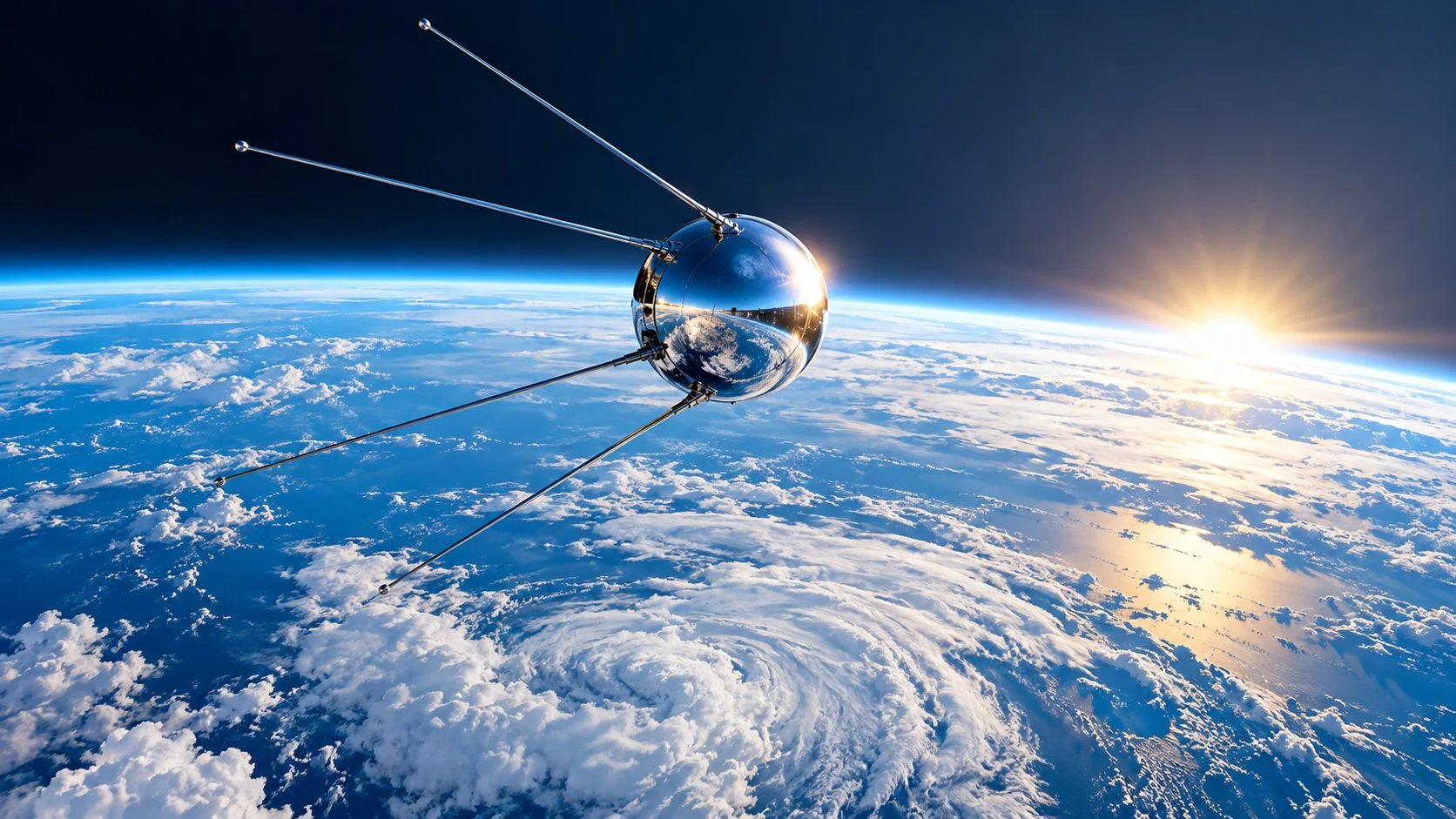
A small sphere with long antennas was enough to change the conversation on Earth. On October 4 in 1957, the Soviet Union launched Sputnik 1, the first artificial satellite to orbit our planet. Its radio signal made the achievement audible to listeners far from the launch site.
NASA's historical account describes a satellite built around a simple transmitter after a more elaborate scientific payload fell behind schedule. The launch belonged to the International Geophysical Year, an international period of coordinated research. It also arrived in the middle of Cold War competition, which gave a relatively small object an enormous political meaning.
The satellite did not need to resemble a futuristic city to make that impression. Something made on Earth was repeatedly traveling around it. The sky had acquired a new kind of presence.
What people saw wasn't always what they thought
One detail in NASA's history is particularly good at rearranging the mental picture. The rocket's larger core stage also reached orbit. Because it reflected more light, that was the object many observers saw when they believed they were watching Sputnik itself.
The event was real. The interpretation of a particular bright moving point could still be mistaken. Looking up supplied an observation, but identifying it required more information.
Radio offered another way to follow the event. Amateur operators could monitor the satellite's repeated signal even when the object itself was not visible to them. Different kinds of observation contributed to understanding what was happening above the horizon.
Sputnik's transmitter eventually fell silent as its batteries ran out in October. The satellite reentered the atmosphere in January 1958. Its direct working life was short compared with the consequences of the launch, which helped accelerate space activity and the creation of NASA.
There is a useful humility in the visual detail. A striking first impression can be correct about the big event while incomplete about the small object in front of you. The answer is to gather another view, rather than to make the original glance carry every conclusion.
Give the room another angle
A workplace has less spectacular blind spots. A door left open can conceal the edge of the wall behind it. A standing view may miss an accessible area beneath seating. A photograph of the main aisle can leave out the low perimeter of the room.
During an office cleaning discussion, look at the space from more than the position where people normally enter. Identify the additional areas that matter and confirm whether they are accessible and within scope. Stay on the building's normal permitted routes and leave restricted areas alone.
A useful record might simply name the location and the reason it deserves attention. That gives the business owner something specific to discuss without claiming the room has been examined in ways it hasn't.
Give your Chino office a fresh angle. Talk with JLV about the everyday cleaning details that fall outside the usual view, and put an overlooked corner back on the map.