
Office cleaning
How to clean raised room signs without wearing down the lettering
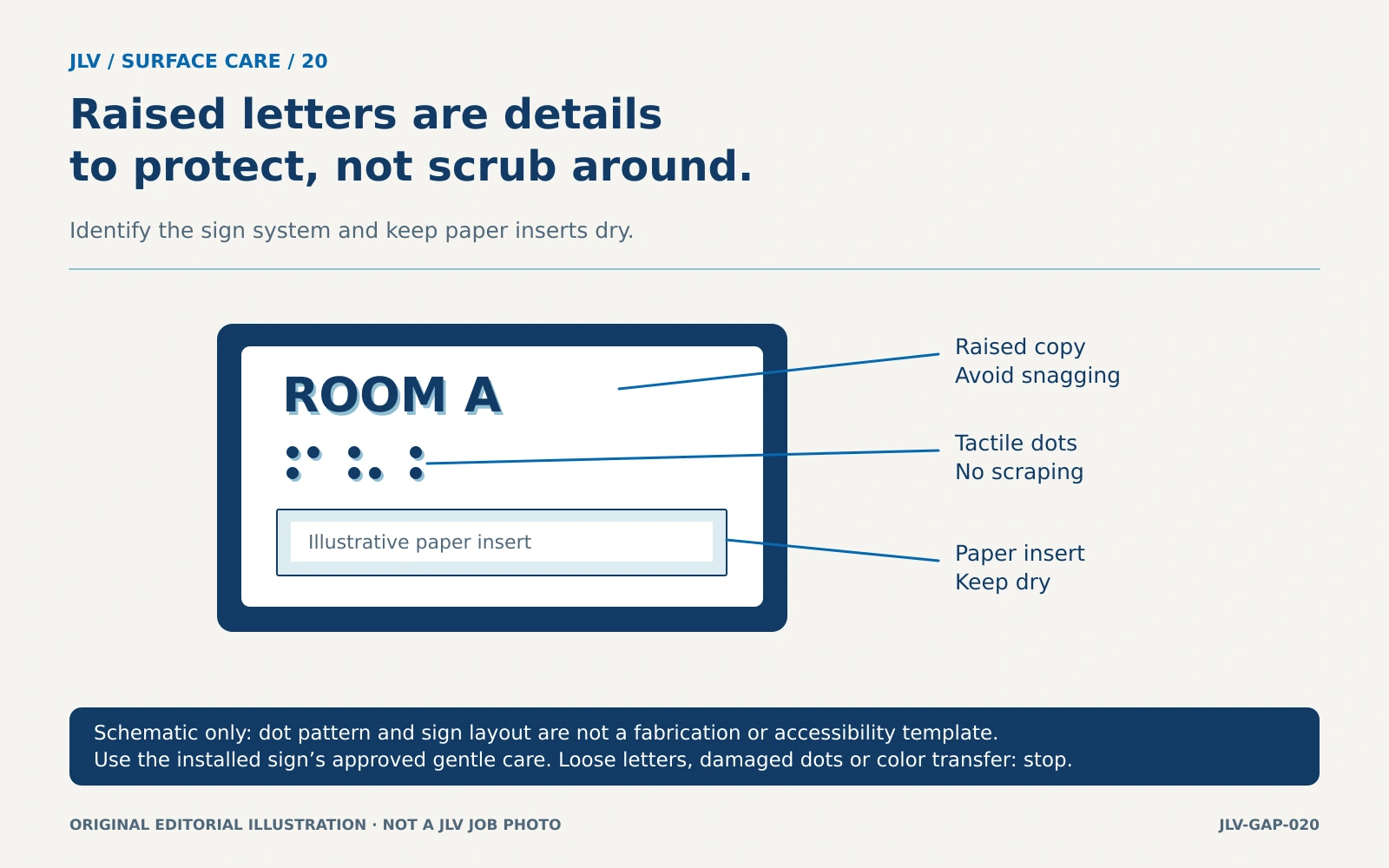
A room sign can contain several surfaces in a space smaller than a sheet of paper: a finished background, raised letters, Braille dots, a frame and a changeable insert. Cleaning the front as though it were a plain plastic partition overlooks those details.
The aim is to remove ordinary dust and marks while preserving the information people use to find a room. Begin by identifying the sign system and checking its condition. Cleaning does not certify accessibility compliance or correct an incorrectly installed sign.
Find the sign’s instructions
Ask facilities for the sign vendor, collection and care sheet. A building may have different sign systems in its original corridor and a recently renovated wing. Separate those groups in the route instructions instead of assuming one cleaner works across the entire property.
Look for paper inserts or visible openings where moisture could enter. Ask the office to identify any removable inserts before work. Do not pull out a directory card or reposition a sign simply to make cleaning easier; those changes need their own authorization.
For a newly completed office fit-out, have the contractor resolve loose mounting or unfinished installation before the regular cleaning team works on the sign. Record installation residue separately from ordinary dust so it does not trigger an improvised adhesive-removal treatment.
Use a gentle method for the identified product
ADAHotelSigns’ care guide recommends a soft dry cotton cloth for its interior raised-copy and Braille signs. For marks, it allows mild soap and water applied to a cloth, gentle treatment and blotting dry. It warns against moisture on paper inserts, gritty rubbing, paper towels, coarse tools, solvents and powerful steam or pressure cleaning.
That is a manufacturer example, not a specification for every tactile sign. Confirm the installed sign is covered by the guidance. For another vendor, obtain that vendor’s instructions rather than borrowing a method because the two signs look similar.
Check a small area and protect the details
Inspect before touching. Note any already loose letters, damaged dots, scratches or separation from the wall. If a part appears unstable, stop and ask facilities to assess it. Do not press it back into place while cleaning.
For a sound sign with an approved method, choose an inconspicuous area of the background for a small trial. Use a clean section of the specified cloth and minimal pressure. Check the result after drying, including the sheen and color, before moving across the visible face.
Work slowly around raised features so the cloth does not catch them. Keep the paper-insert area dry. This is a practical handling precaution, not an instruction to insert a tool behind lettering or into a frame. If dirt remains where it cannot be safely reached, document it and ask the sign supplier for an approved approach.
Stop when the sign itself is changing
A cleaning attempt should not change the sign’s surface or the way its features are attached. Stop if color transfers unexpectedly, the finish becomes cloudy or tacky, a letter shifts, or the cloth snags a damaged feature. Tell facilities which sign was affected and what was observed.
Persistent staining is also a reason to reassess. Do not scrape around Braille, use a polishing compound, repaint the lettering or substitute a stronger chemical. A replacement or specialist repair decision belongs with the owner and sign supplier.
A useful completion note identifies which signs received routine care, which were skipped and why, and who needs to review a defect. A photo can support that record, but avoid capturing confidential names or room information unnecessarily.
For an office or post-construction cleaning plan, contact JLV with the sign vendor’s instructions and the areas involved. Confirm ordinary cleaning tasks and the process for reporting damaged signs before work begins.