
Office cleaning
Encapsulation or Extraction: Which Does This Office Carpet Need?
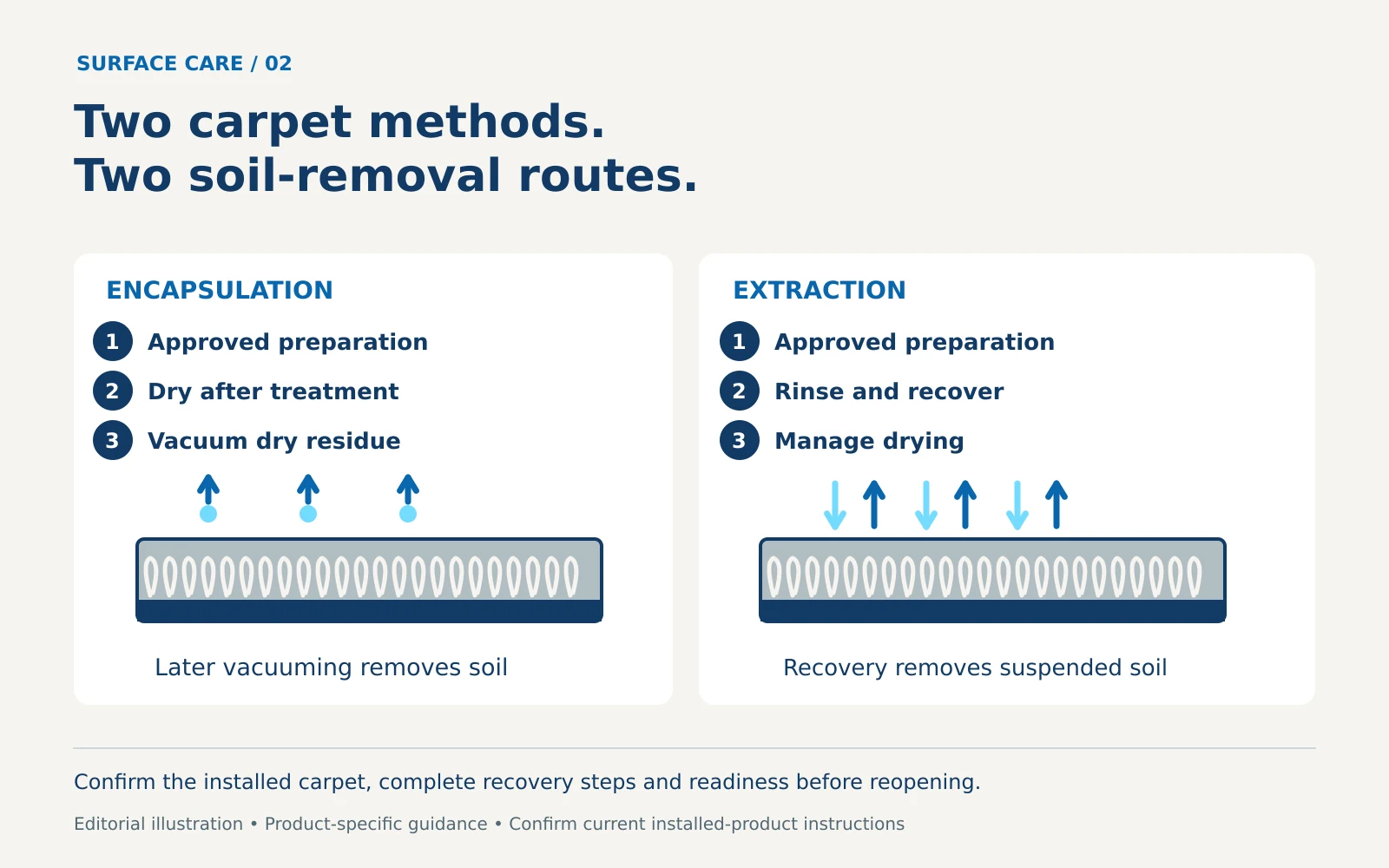
Choose encapsulation when the installed carpet permits an interim appearance clean; consider manufacturer-approved extraction when the maintenance plan calls for restorative soil removal. Before accepting either proposal, ask how the loosened soil will leave the carpet. The service name alone does not describe a complete job.
Start with the carpet and the problem
Ask facilities for the manufacturer, product line, fiber, backing and installation details. Locate the applicable care guide and any maintenance records. A familiar-looking carpet tile is not enough to identify a compatible chemical or machine.
Then record what prompted the request. Is there ordinary traffic-lane dulling, a localized spill, widespread residue or uncertainty about the last restorative service? Note the affected rooms, accessible area and any loose seams or damaged tiles. Keep unknown post-construction contamination outside a routine carpet-cleaning decision until the responsible site contact has assessed it.
This information turns “clean the carpet” into a question a provider can answer. It also prevents one visible spot from automatically becoming a proposal to treat every room.
Understand the two soil-removal routes
For a specific manufacturer example, Interface's carpet-tile guide describes encapsulation as pre-vacuuming, applying a suitable solution, working it with counter-rotating brushes, allowing it to dry and vacuuming again. Its extraction sequence includes pre-vacuuming, pre-spray, agitation, rinsing and recovery, with additional suction passes. Interface identifies hot-water extraction as its restorative method and advises against bonnet cleaning. These instructions apply to its products; confirm the current guide for your installation.
Avoid converting those descriptions into a universal machine setting, chemical recipe or drying promise. A provider should be able to identify the actual equipment and solution proposed for the carpet in your office.
Make the decision in three steps
- Check the maintenance purpose. If the request is to refresh appearance between scheduled restorative services, ask whether encapsulation fits the approved plan. If the restorative service is due, an interim visit should not silently replace it.
- Check the complete scope. Ask where preparation, spot assessment and final soil recovery appear in the proposal. For encapsulation, establish who performs the finishing vacuum and when. For extraction, ask how recovery and drying will be managed.
- Check the operating window. Identify the latest acceptable reopening time, furniture access and available ventilation. Have the provider confirm whether the proposed method fits those conditions. A short vacancy window is a reason to reconsider timing, rather than remove a necessary step.
Stop the selection process if the carpet identity is unresolved, the proposed treatment conflicts with its guide, or the provider cannot explain soil recovery. Ask for clarification before approving the work.
An example scope review
Imagine a conference suite receiving two proposals. One lists “low-moisture carpet cleaning”; the other lists “hot-water extraction.” Neither identifies the carpet or the reason for selecting the process.
Send both providers the same product information and ask for these additions:
- The condition they are addressing and the method's role in the maintenance plan
- Preparation, spot assessment and accessible areas
- The approved solution and compatible equipment
- Soil-removal steps, including any later vacuuming
- Drying arrangements, reopening checks and treatment limitations
A useful answer might reveal that one proposal is an interim visit and the other a restorative service. Compare them against the work actually needed rather than treating their totals as interchangeable.
Agree on the acceptance check
Before broad treatment, request an approved trial area where appearance or compatibility is uncertain. Compare it after drying under the same lighting. Stop for new discoloration, texture change or lifting edges; record the condition and obtain product-specific advice before continuing.
At handover, review the treated areas, remaining marks and any recommended next step. Record the method and date for the next maintenance decision. Avoid promising that cleaning will reverse wear or every stain.
For a related planning framework, see commercial floor care across mixed surfaces.
For an office or business cleaning quote, contact JLV Cleaning & Maintenance in Orange County, Chino Hills, Chino, Ontario, Corona or Eastvale. Include the carpet information and ask which work can be included in the proposed scope.