
Office cleaning
Dusty office ceiling tiles: when is damp cleaning allowed?
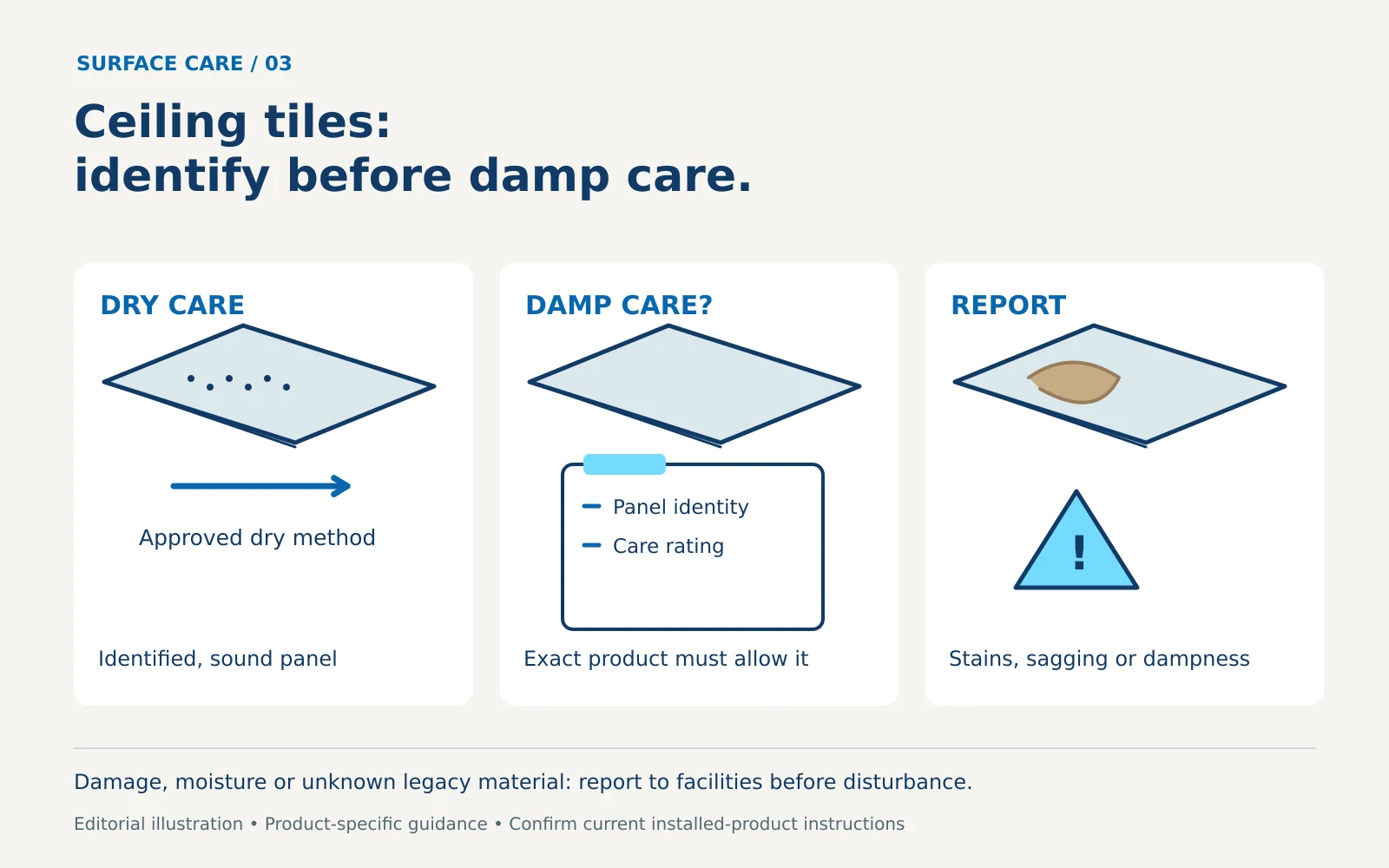
A dusty ceiling tile may be suitable for careful dry cleaning, but damp wiping depends on the exact panel and facing. Confirm the installed product before bringing water overhead. A sagging, damp, damaged or unidentified legacy panel belongs with facilities for assessment rather than a cleaning experiment.
Establish what is overhead
Ask for the ceiling schedule, purchase record or maintenance manual. Record the manufacturer, product name, facing and room location. Similar white panels can have different constructions, and replacement tiles may not match the surrounding installation. Do not remove a tile merely to search for a label when access, services or material safety is uncertain.
Decide whether the problem is loose surface dust, an isolated mark or a change in the panel itself. Photograph it from a safe position. A spreading ring, displaced panel or damp patch needs a separate building response. A cleaning quote should not silently convert those observations into permission to disturb the ceiling.
Choose the care route
For its ceilings, Armstrong describes one-direction dust removal using a brush or upholstery vacuum attachment. It lists an art-gum eraser for certain marks. Its limited damp-cloth, mild-soap method applies to suitable mineral-fiber and fiberglass panels, uses minimal water and excludes cloth-faced panels. Individual performance ratings determine whether more intensive cleaning is permissible. Armstrong also warns that field painting can affect performance and warranties, with product-specific exceptions. These are manufacturer instructions, not approval for every suspended ceiling. Read Armstrong's ceiling maintenance guidance.
Use those distinctions to write one of three decisions on the work order:
- Dry care approved for an identified, sound panel with ordinary loose soil.
- Limited damp care considered only after the exact product instructions permit it.
- No cleaning attempt until identification, damage or access concerns are resolved.
The third decision is a useful result. It prevents repeated attempts by different people who otherwise see only an unfinished mark.
Make the test meaningful
Before an approved test, agree who can authorize ceiling access and protect the area below. Staff should not stand on an office chair or improvise a reach around lights and sprinklers. The access arrangement must suit the task, independent of whether the cleaning method is gentle.
Choose a small, discreet area of the same identified finish. Record the tool and permitted solution. Compare the dry result with adjacent untreated material under normal room lighting. Stop if the face rubs away, fibers loosen, the finish changes, an edge becomes soft or the mark spreads. Do not increase pressure simply because one pass did not remove a spot.
A successful dry test does not approve a wet process. A successful test on one panel does not establish that replacement panels elsewhere have the same facing. Keep the approval tied to the product and area that were actually checked.
Example for an office corridor
A manager reports “dirty tiles near reception.” A walkthrough finds loose dust on most panels and a separate brown ring above a doorway. The useful scope identifies the dusty, documented panels for a controlled care test, while the ring goes to facilities with its location and photograph. The completion record notes which panels were cleaned and which remained untouched pending review.
Use this handoff checklist:
- Panel identity and applicable care document recorded
- Ordinary soil separated from damage or moisture concerns
- Access and protection of occupied areas arranged
- Test location, dry result and approval recorded
- Remaining marks assigned to an owner instead of repeatedly scrubbed
For office/business or post-construction cleaning in Orange County, Chino Hills, Chino, Ontario, Corona or Eastvale, request a JLV quote with the ceiling details and access conditions. Confirm any overhead specialty work separately.