
Office cleaning
Dusty Hanging Acoustic Panels: Clean in Place or Arrange Removal?
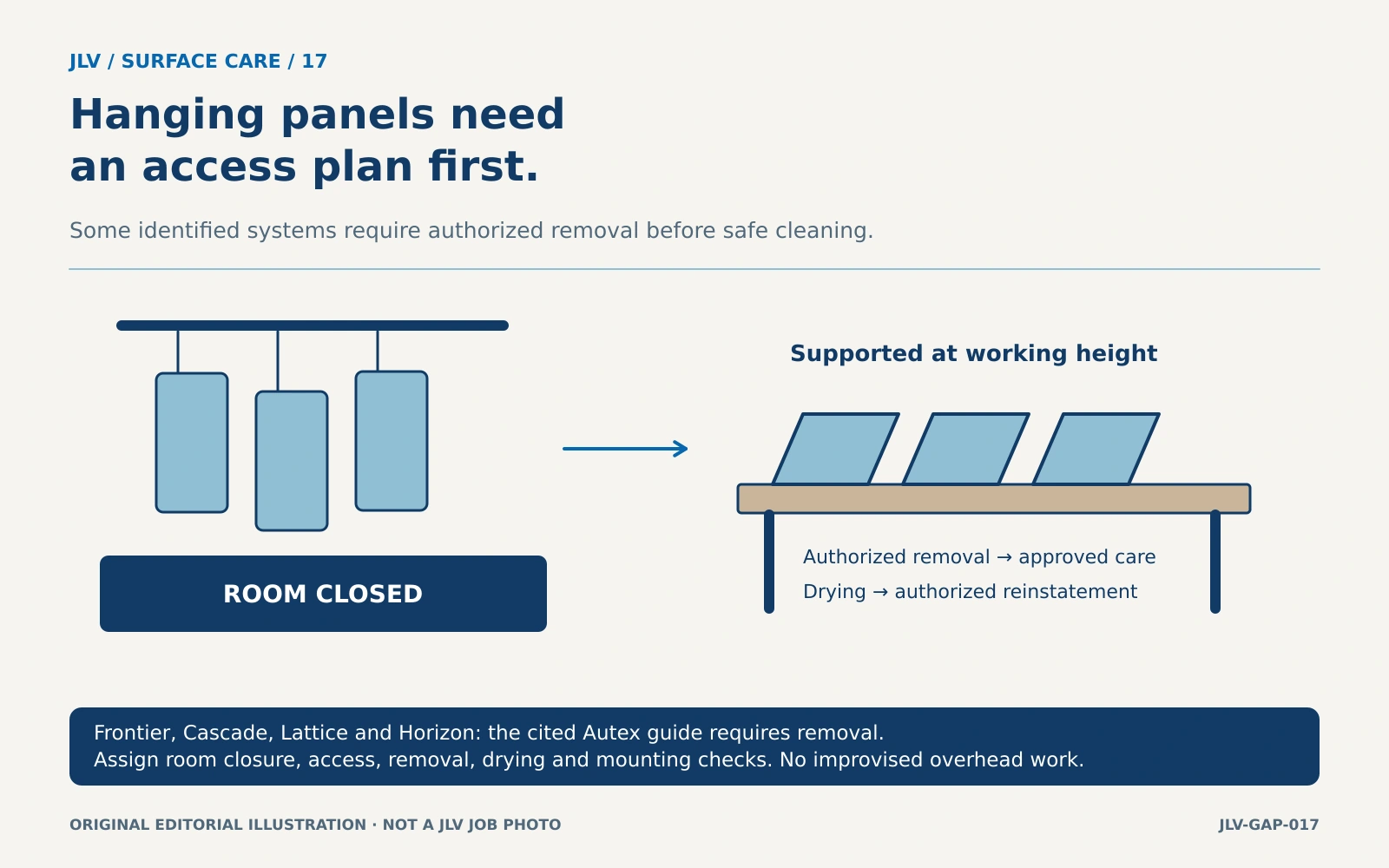
Before booking cleaning for hanging acoustic panels, find out whether the installed product must come down first. That decision changes the room closure, access arrangements and people needed for the work. An extension tool does not make every suspended panel suitable for cleaning in place.
Identify the complete acoustic system
Ask facilities for the manufacturer, product name, finish, installation instructions and care guide. A project photograph is helpful, but a felt-like appearance is not enough to identify the material or mounting system. Record whether the product hangs from cables, fits a grid, attaches to a wall or forms part of a custom assembly.
Autex's current US care guide specifically says Frontier, Cascade, Lattice and Horizon need removal from the ceiling or wall for safe cleaning. It refers to each product's installation instructions for disassembly. That requirement applies to those named systems; it should not be extended automatically to every acoustic product. Autex care and maintenance guide.
For another system, obtain its own access and cleaning requirements before deciding on in-place work. Printed, coated or custom-faced products also need confirmation that the proposed method fits the actual finish.
Divide the work before scheduling the room
Make the responsibilities explicit rather than placing a general “high dusting” line on the work order. A useful plan identifies:
- Who is authorized and qualified to remove and reinstall the panels
- Who provides suitable access equipment and controls the area below
- Where removed panels can be supported, identified and cleaned
- Who checks the attachment system before the room returns to use
- What happens if a damaged panel or fitting is discovered
This is a facilities and installer coordination task as well as a cleaning task. Do not release suspension fittings, stand on office furniture or improvise a removal method. If the necessary access or removal work is unavailable, leave that part of the cleaning scope pending.
Choose a room closure that allows for cleaning, drying and reinstatement. Move meetings or workstations before the visit rather than expecting people to work beneath overhead activity. Confirm the plan with whoever manages the occupied space.
Start with the approved ordinary-dust method
Autex's guide supports light vacuuming, concealed-area testing and compatible mild-detergent spot care followed by rinsing and blotting. It warns against severe abrasion and stiff brushes. Keep these directions tied to the products covered by the guide. The document also contains more aggressive stain-treatment options alongside a general solvent warning; unusual stains should go back to the manufacturer for clarification. Autex product-care instructions.
Once the panels are safely accessible, inspect them before touching the surface. Record existing dents, tears, loose edges or distortion. Test only a manufacturer-approved method in a concealed location and inspect it after drying. Changes in color, texture or adhesion are stop signals.
If ordinary dry care resolves the dust, there is no reason to add a wet stain treatment. Where spot cleaning is approved and needed, follow the product instructions and cleaner label without broadening the job into whole-panel saturation. A persistent mark needs a separate decision rather than an improvised chemical sequence.
Treat construction residue as a separate question
Ask the project team what work created the deposit. Ordinary settled dust and unknown construction residue should not be treated as interchangeable. Paint, adhesive or a deposit whose hazards have not been assessed belongs on the project handoff list before anyone tries removal.
For that wider planning issue, read fine dust after renovation. Cleaning appearance alone cannot confirm that construction hazards have been controlled.
Close out the room with clear checks
Allow cleaned panels to dry fully before authorized reinstatement. Keep panel locations identifiable without putting unapproved tape on their faces. Have the responsible person check the completed installation and report any unresolved marks separately from the mounting inspection.
The handoff should state what was cleaned, what remained and who reinstated the system. Avoid describing the result as restored sound absorption or verified acoustic performance; those outcomes are outside an appearance-cleaning check.
Contact JLV to discuss the routine cleaning portions of your office scope and identify access or installer coordination that must be arranged separately.