
Office cleaning
Dull VCT Floors: Scrub and Recoat or Strip the Finish?
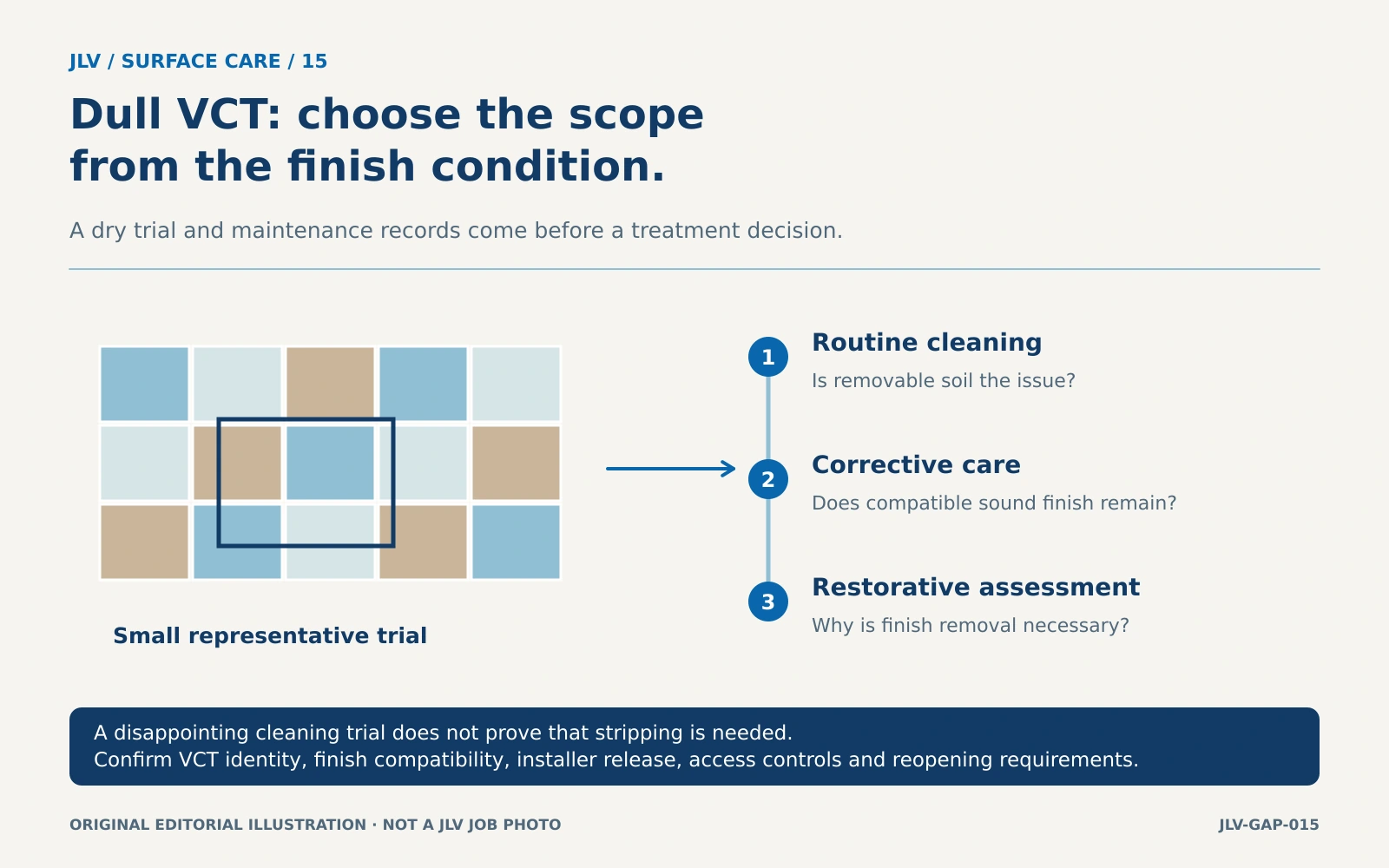
A dull VCT floor does not automatically need stripping. First establish whether ordinary soil is hiding the finish, whether the existing polish can be maintained, or whether a floor-care professional needs to assess removal of the finish. Those choices involve different work, downtime and costs.
For an office manager, the useful starting point is a documented condition check and a small approved trial. A promise to “bring back the shine” leaves too many decisions unspecified.
Identify both the tile and the finish
Confirm that the floor is vinyl composition tile, usually abbreviated VCT. Find the product name, installation date, current maintenance instructions and records of the polish already applied. Ask who last maintained it and whether different products have been layered over time.
Do not transfer this decision process to luxury vinyl tile, linoleum, rubber or an unidentified older floor. A familiar square tile pattern is not a reliable product identification. If the material or coating cannot be confirmed, pause machine work and chemical treatment while the owner or flooring supplier identifies the system.
Recent construction adds another question: has the installer released the floor for the proposed maintenance? Include that release in the handoff rather than assuming the building's opening date settles it.
Separate the possible scopes
Armstrong's VCT guide distinguishes routine loose-soil removal and damp cleaning from corrective machine scrubbing. After approved scrubbing, rinsing and drying, additional polish may be appropriate; with enough sound polish remaining, its guidance also allows gloss maintenance by buffing or burnishing. Restorative stripping removes existing polish and requires a subsequent finish application. These are instructions for that manufacturer's VCT system, not a universal resilient-floor recipe. Armstrong VCT maintenance instructions
Use that distinction to ask for one of three clearly described assessments:
- Routine cleaning: determine whether removable surface soil accounts for the dull appearance.
- Corrective cleaning and possible recoating: evaluate whether a compatible, sound finish remains that can receive further maintenance.
- Restorative assessment: explain why removing the existing finish is necessary and what will happen afterward.
“Scrub and recoat” should describe a complete proposed process. Ask what cleaning, soil recovery, preparation, finish compatibility checks and drying periods it includes. Ask the same questions if a proposal uses “strip and wax,” since that shorthand does not identify the actual products.
Make the trial answer a question
Agree on a small representative area and photograph it under the same lighting as an adjacent untreated section. The operator should select the trial method from the installed floor and finish instructions. Record the products and equipment used so the result can be repeated deliberately.
Let the area dry before comparing it. Did visible soil improve? Is the appearance now acceptable for the space? Did an unexpected color or surface change occur? A successful cleaning trial may support staying with a simpler scope. A disappointing trial is a reason to reassess; it does not prove that stripping is the correct next step.
Stop if the trial produces damage or an unexplained change. Report loose tiles, damaged seams, unfamiliar coatings or possible installation defects to the property contact before further wet or abrasive work.
Approve the work and the reopening plan together
Before signing off, request a written description of:
- The specific rooms and traffic lanes included
- The condition observed and the reason for the chosen treatment
- Product compatibility and responsibility for approving it
- Furniture movement, access controls and the usable walking route
- Drying or cure requirements and who authorizes reopening
- Existing damage that cleaning is not expected to correct
For example, an acceptable trial in a reception area does not automatically approve the same work in a storage room with an unknown finish history. Record the difference and price any additional assessment separately.
Keep the final expectation practical: an agreed improvement in condition, with the floor returned according to the approved maintenance system. Do not make maximum gloss the only acceptance criterion.
For office or business cleaning, contact JLV to discuss the cleaning scope. Describe the floor, the concern and any available maintenance records so routine cleaning and any separately needed specialist work can be discussed clearly.