
Office cleaning
Cleaning floors with wayfinding decals: when to stop at a lifting edge
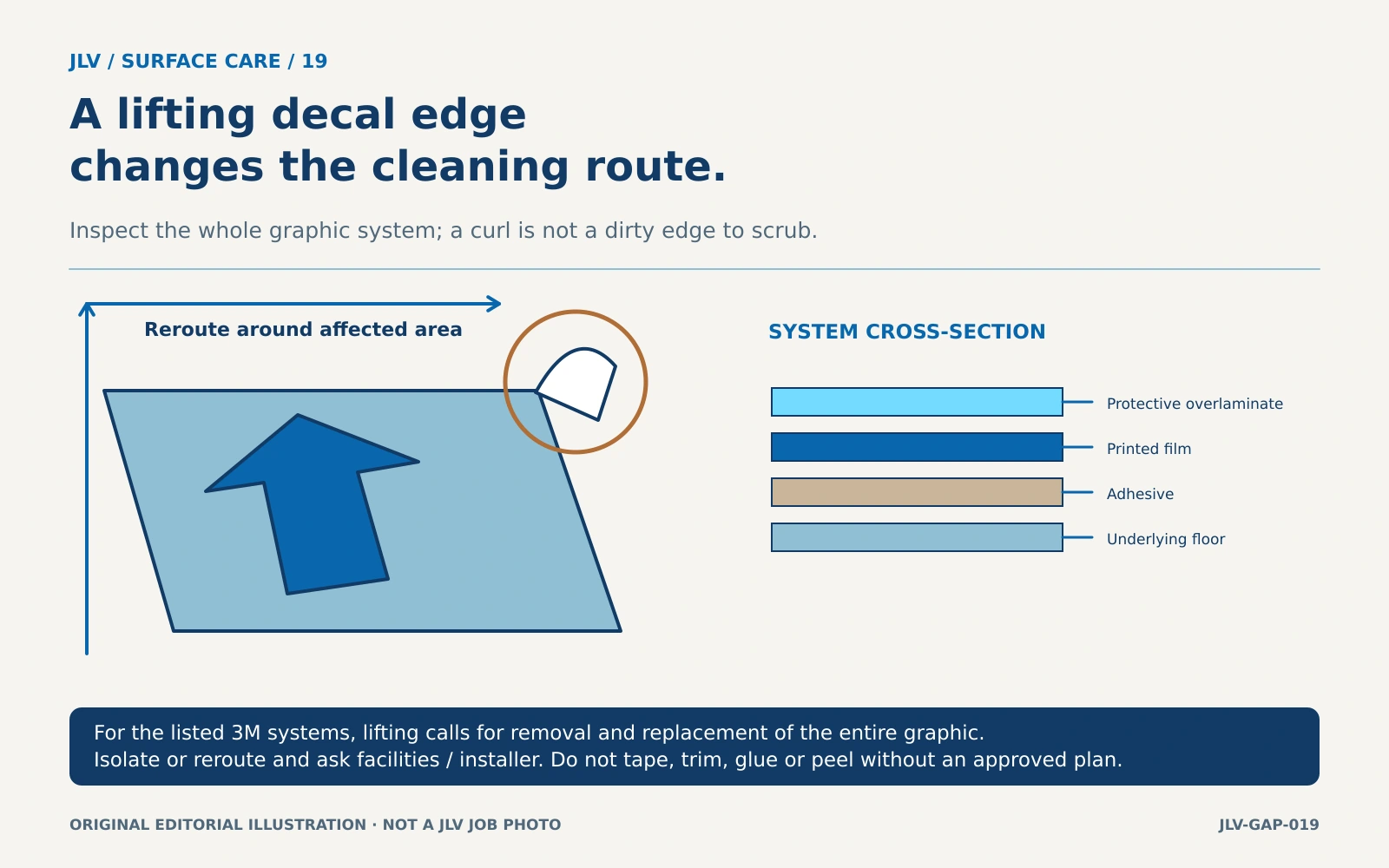
A directional arrow on an office floor changes the cleaning plan for that small area. The flooring beneath it may tolerate a machine pass that the printed film, overlaminate or adhesive does not. If an edge is already lifting, the next step is to control the hazard and arrange a decision about the graphic.
Start with the condition of the decal rather than the cleaner bottle. A curling corner should not be treated as a stubborn dirty edge. Cleaning around it may be part of an immediate access plan, but it does not repair the failing graphic.
Identify the complete graphic system
Ask the person who ordered the signs for the installer’s records. The useful details are the print film, protective overlaminate, installation date, underlying flooring and any finish applied over the graphic. A printed brand name alone may not identify the complete system.
Mark each graphic on the cleaning route, including arrows partly hidden under queue furniture. Record whether it is an indoor floor graphic or an outdoor sidewalk product. Keep the instructions with the route information so a replacement cleaner does not have to guess.
If the system is unknown, hold machine treatment over the graphic while facilities obtains the care requirements. Continue only the independently approved work elsewhere, maintaining a safe route through the space.
Inspect the edge before choosing a method
Look for curled corners, detached edges, splits, bubbles and worn areas. Do not deliberately lift a sound corner to inspect underneath. Record the location and condition without making the defect worse.
3M’s December 2024 floor-graphics bulletin says that any lifting from the walking surface calls for removing and replacing the entire graphic. Its indoor floor-graphics maintenance instructions also restrict buffing unless the graphic is regularly waxed. Those directions apply to the listed 3M product systems; they are not permission to wax an unidentified decal.
A lifting edge needs prompt facilities attention. Isolate or reroute around the affected area as the site’s access plan requires. Do not tape over it, trim it, glue it down or peel it away without an approved repair or replacement plan.
Check installation timing and compatibility
A newly installed graphic can look ready for service while still being within a no-cleaning period. Ask for the installation time and the installer’s release instructions before scheduling the first wet visit.
For example, Avery Dennison’s PVC-laminate guidance says its films should not be washed during the first 48 hours after application and excludes solvents and abrasive cleaners. That example is specific to the cited guidance. Do not combine its timing with another manufacturer’s wax procedure to invent a universal specification.
Once the correct method is established, test it on a small approved section of sound graphic. Let it dry and check color, surface appearance and edge condition. Stop if the print changes, the surface becomes tacky or an edge begins to move. A successful test does not override a stated manufacturer restriction.
Agree on the replacement boundary
The cleaning team, building manager and sign installer need a clear division of responsibility. Who can authorize removal? Who will protect the underlying finish? Who confirms the replacement arrow still points visitors in the right direction? These questions matter even for an inexpensive decal.
After authorized replacement, add the new product and installation date to the route record. Ask the installer to explain the care method and the point when ordinary maintenance may restart. Appearance alone is not a slip-resistance certification, and this cleaning checklist does not provide one.
For office floor-cleaning planning, contact JLV with photos of the graphics, the flooring information and available installer instructions. Agree on the cleaning scope and any facilities handoff before the next machine visit.