
Office cleaning
Can restroom partitions be washed down? Check the core first
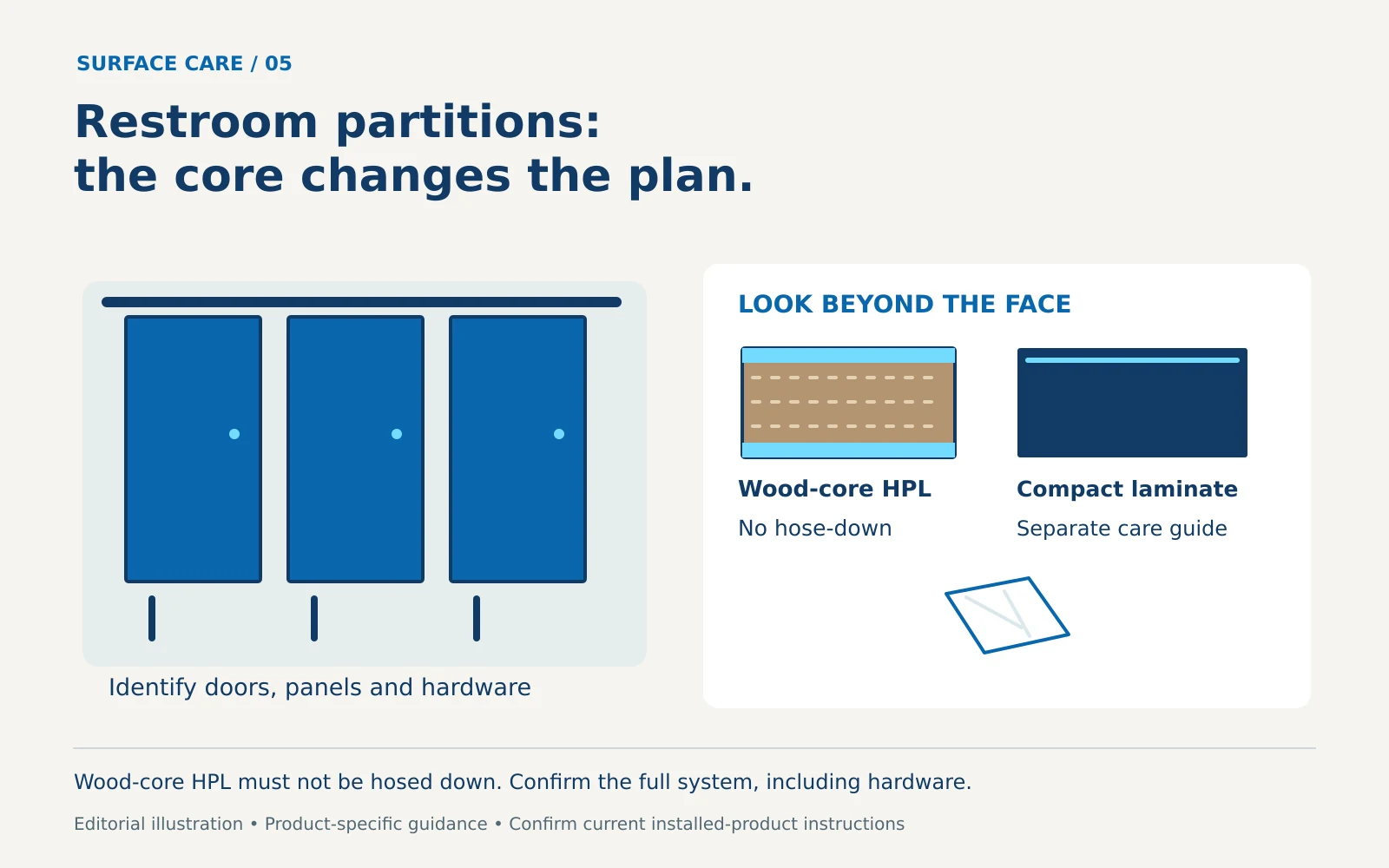
Do not hose down a restroom partition just because its surface looks waterproof. Identify the partition system and core first. Bobrick explicitly excludes wood-core high-pressure laminate partitions from hose-down cleaning because water can damage the substrate. A controlled wiping scope is a more appropriate starting question for that product.
Identify the entire partition system
Start with the building's finish schedule, partition submittal or supplier record. Capture the maker, series, panel construction and hardware finish. High-pressure laminate over a wood-product core and compact grade laminate are different constructions. The exposed face does not settle which one is installed.
Include doors, panels, pilasters, brackets and floor connections in the inventory. A room can contain replacement pieces or hardware from another series. If a record is missing, ask facilities or the installer to identify it; do not drill, scrape or dismantle a panel to find out.
Look for lifted edges, swollen lower corners, open joints, scratched faces and loose fittings before work begins. Record those defects separately. A panel with an existing failure needs an owner decision, even if ordinary fingerprints elsewhere can be removed.
Use the manufacturer method within its scope
Bobrick's TB-60 directs ordinary dirt, smudges and fingerprints to a mild cleaning solution, using a cloth or sponge on smooth faces and a soft brush on textured faces, followed by rinsing and drying. It prohibits hose-down methods on wood-core HPL and warns against chlorides. Its CGL advice includes ventilation where hose-down or shower conditions exist. The bulletin also lists chemicals that can damage HPL and cautions about hardware exposure. Permission for one panel construction does not approve every adjoining material. Read Bobrick TB-60.
For a documented compatible system, specify controlled application rather than uncontrolled runoff. Agree how residue will be removed without saturating joints or wetting adjacent finishes. Keep products intended for toilets or other restroom surfaces out of the partition procedure unless the exact manufacturer instructions independently permit them.
Test the face and protect the edges
Select an inconspicuous, intact area representative of the finish. Use the approved product and tool at the label's directions. Review the result after it is dry: check color, sheen, texture and any residue. Stop if the finish transfers to the cloth, becomes dull, softens or shows a new mark.
Do not use an already swollen edge as the test patch. Do not keep adding water to prove whether a panel can tolerate it. Where identification or compatibility remains uncertain, the decision should be “await product guidance,” not “try a stronger restroom cleaner.”
During the work, watch for runoff toward hardware and floor connections. If a damaged section or leak becomes visible, pause that section and notify the responsible person. This article addresses ordinary soil, not body-fluid incidents, suspected mold or hazardous contamination.
Example of a useful scope correction
A request says “wash down all stalls after renovation.” The finish schedule identifies wood-core HPL doors, while several replacement panels are not documented. Rewrite the task to separate approved surface wiping on identified intact panels from identification of the replacements. List construction residue individually; paint, adhesive and sealant require their own compatibility decisions rather than extra scrubbing.
At handoff, check:
- Correct panel series and core recorded
- Hardware and adjacent finishes considered
- Existing swelling or delamination photographed
- Small dry-result test accepted
- No assumption that a CGL permission covers HPL
- Unresolved residue or damage reported by location
Request a JLV office/business or post-construction cleaning quote for Orange County, Chino Hills, Chino, Ontario, Corona or Eastvale. Share the partition specification and condition photos so the cleaning scope can be confirmed before work.