
On this day
London Went Underground. The Journey Still Began Outdoors.
Historical event:
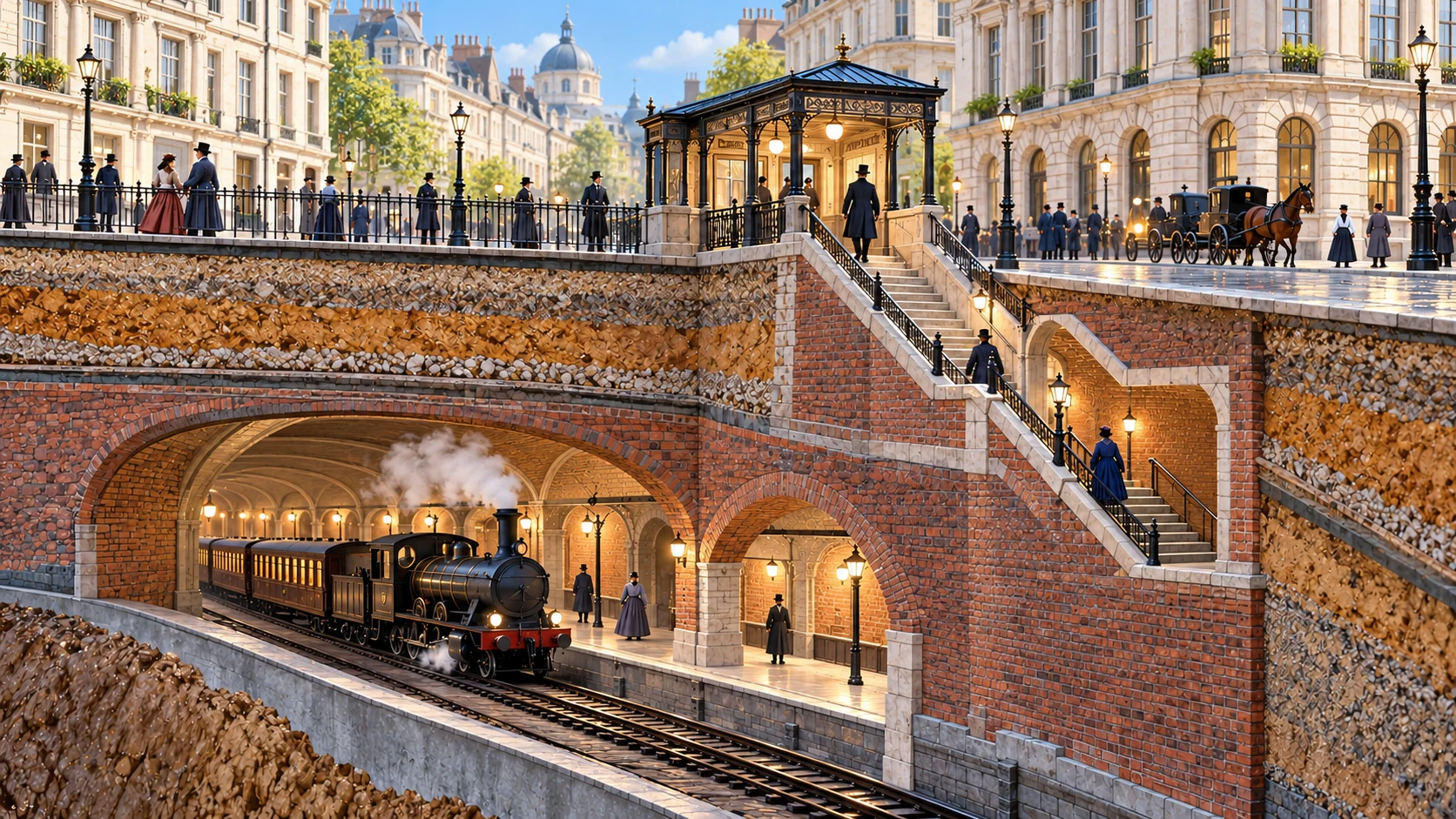
On January 10 in 1863, London passengers could do something entirely new: take a public underground railway. The Metropolitan Railway connected Paddington with Farringdon Street through King's Cross, putting part of the city journey beneath the city itself.
The London Transport Museum records 40,000 passengers on that opening day. Its account also notes that much of the route was built by the cut-and-cover method. The phrase is fairly literal: construction involved opening the ground from above and covering the railway afterward. The earliest underground was a major intervention in the streets, rather than a train line quietly slipping into an untouched world below.
Another detail catches modern imaginations by surprise. These were steam trains. The first chapter of underground travel arrived before the electric trains many people instinctively picture when they hear the word subway.
A new route, with familiar endpoints
The technical novelty happened below ground, but the passengers still had ordinary places to reach. A railway could carry someone toward a destination; it couldn't eliminate the rest of the journey. There would still be a street, an entrance, a doorway, and the last few steps into a building.
That makes the original route interesting beyond its place in transport history. It changed one part of a connected sequence. The station was a meeting point between two environments, and people moved between them carrying the evidence of wherever they had just been.
Think about a commute today. The train or car tends to get the credit for the journey. The short walk from the parking area or station receives much less attention, even though it is the part that delivers you to the office door. In a building's daily life, those final steps matter.
The first passengers were trying a new kind of journey, but their destinations still had front doors. That last transition is easy to miss when the train gets the attention. It is where the grand transport story becomes the ordinary business of arriving.
Start with the first few steps
For office cleaning, consider the entrance and immediately adjoining flooring together. On a walkthrough, notice the mat, the hard floor beside it, and the first carpeted area beyond. After a wet or dusty day, those same locations can be useful places to review with the person responsible for the space.
OSHA and NIOSH include walk-off mats among measures to reduce dirt being tracked into buildings. That doesn't mean a mat ends the work at the threshold. Its condition, the surrounding floor, and the building's own access arrangements still belong in the discussion. Ask for a plan suited to the actual entrance rather than a generic instruction for every doorway.
For an Ontario office, the welcome begins where the outside comes in. Tell JLV about the entrance your team uses every day, and let's discuss office cleaning that gives those first few steps their due.