
Office cleaning
How to report a persistent office odor without guessing its cause
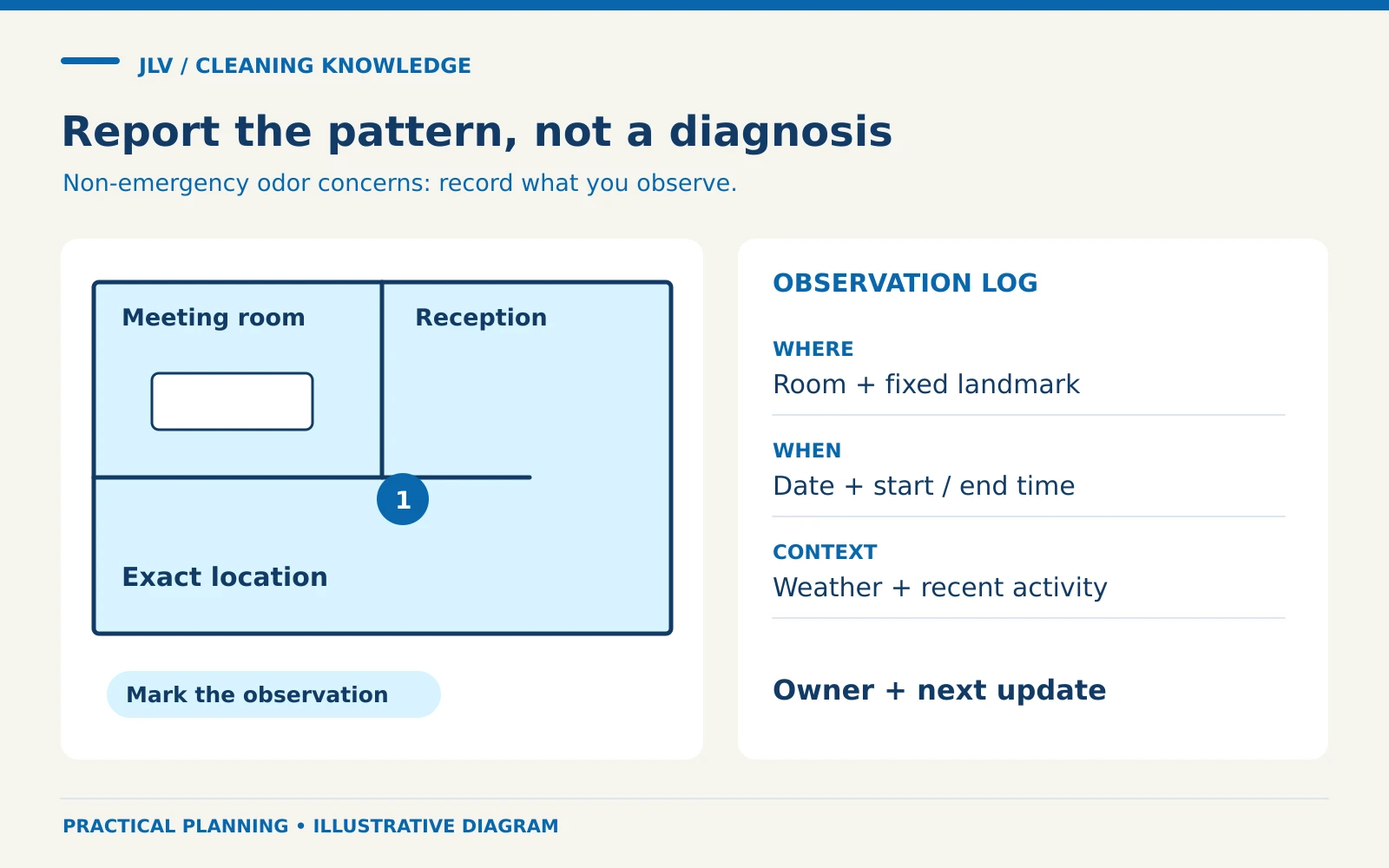
An office odor report is most useful when it describes what happened instead of announcing a diagnosis. “Musty smell near the north meeting room after rain” gives a building manager something to investigate. “The cleaners caused mold” assumes a cause the observer has not established. Start with a clear record, the right contact and a plan for follow-up.
First decide whether this is an emergency
Do not use an odor log to delay leaving a potentially dangerous area. SoCalGas advises leaving immediately if a gas leak is suspected and calling from a safe location. Follow the building emergency plan for suspected gas, smoke, strong chemical releases or people becoming acutely unwell. Do not deliberately sniff containers or enter an enclosed space to locate a source. SoCalGas emergency information
The remaining steps concern a non-emergency, persistent concern that building management has agreed can be reported through its ordinary process. Absence of a strong smell is not proof that air is safe.
Record the location precisely
Identify the building, suite, room and nearest fixed reference point. “Reception beside the east wall” is more useful than “downstairs.” If the smell seems to occur in several locations, record each location separately rather than drawing an assumed path between them.
Use a floor-plan marker or a photograph of the room from normal standing height. Do not photograph coworkers, private papers or an occupied restroom. Describe the odor in ordinary language: musty, sour, smoky or similar. These words are observations, not chemical identification.
Add timing and context
For each occurrence, record the date, approximate start and end time, whether it was present on arrival, and any noticeable change. Add observable context such as recent rain, a delivery, nearby painting, a closed room or an overflowing waste container. Record a recent cleaning visit as one event among others, without assuming it explains the concern.
EPA recommends communicating indoor-air concerns to the people responsible for the building and providing information that helps them investigate patterns. Building systems, maintenance and occupant activities can all be relevant. EPA office occupant guide
Use a neutral report template
Send this through the building's approved channel:
- Location and access contact:
- Date and time observed:
- Description in ordinary words:
- Whether this is new, recurring or continuous:
- Visible observations, such as a stain or damp area:
- Recent activities or weather, if known:
- Areas affected and any area already closed by management:
- Requested next step and person responsible for replying:
Keep employees' medical information out of a shared cleaning ticket. Anyone with health concerns should use the employer's appropriate confidential process and seek medical advice when needed.
Separate cleaning from investigation
Ask the cleaning provider to confirm the agreed tasks and report visible conditions within its work area. Ask building management to decide whether plumbing, moisture, ventilation or another qualified inspection is needed. Do not ask a routine cleaning crew to open walls, dismantle equipment or certify indoor air quality.
For example, a hypothetical log might show an odor beside a utility closet on three wet mornings but not on dry afternoons. That pattern supports a targeted facilities review. It does not prove a leak, identify a microorganism or determine a treatment.
Close the loop without masking the problem
Record who accepted the report, the next update date and any instruction about access. After an authorized repair or agreed cleaning task, record whether the odor recurs under similar conditions. Avoid adding fragrance merely to hide the observation before the investigation.
Stop routine work in the affected area if conditions become hazardous, an unknown liquid appears, building management closes the space or the agreed cleaning scope no longer fits. Use JLV's office responsibility guide to separate cleaning tasks from building repairs, then include only the confirmed cleaning work in a quote request.