
Office cleaning
How to prepare an office for pest-control service without mixing responsibilities
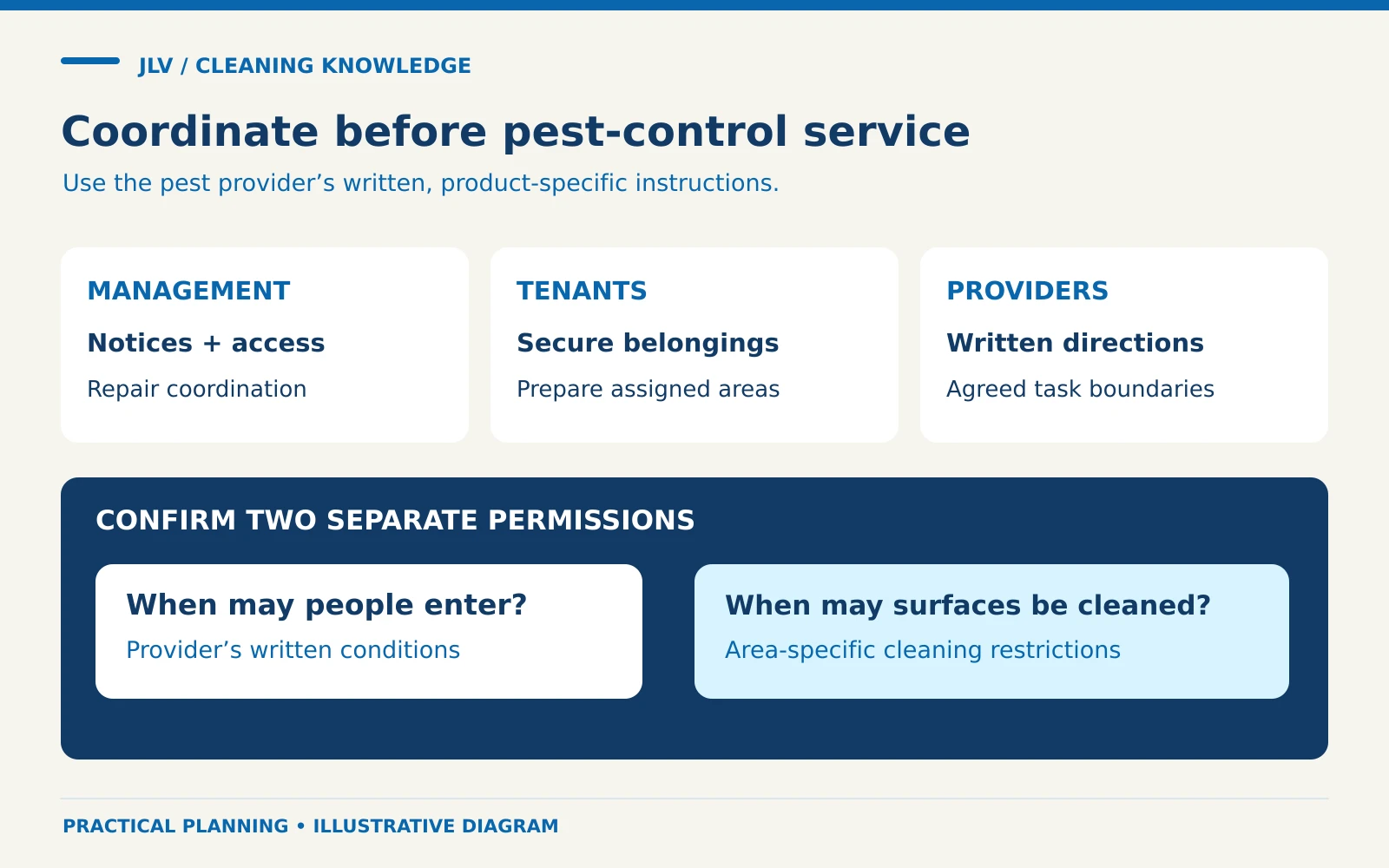
Prepare an office for pest-control service with one shared instruction sheet from the pest provider, building management, and the cleaning contact. It should identify the affected rooms, preparation tasks, access restrictions, and the conditions for resuming cleaning.
Treat the pest provider’s written, product-specific directions as essential scheduling information. Do not assume that a room is ready for cleaning because the appointment has ended or the office is empty. Treatment methods and follow-up requirements differ.
Ask for instructions before assigning work
Have management obtain a written preparation list from the appropriately licensed pest provider. Ask which rooms need access, whether cabinets must be emptied, which ordinary surfaces should be cleaned beforehand, and who may move furniture or equipment. Request the timing early enough for tenant belongings and restricted records to be handled by their owners.
Ask whether the visit involves inspection, monitoring, pesticide application, or another method. The answer affects both preparation and the cleaning schedule. Do not create a generic “deep clean everything” order that could conflict with the planned service.
Where pesticides will be used, request the product information and directions relevant to occupants and cleaners. EPA emphasizes following pesticide labels; those instructions should anchor the provider’s guidance. EPA pest-control precautions.
Divide the preparation tasks
Building management should coordinate tenant notices, access, and any repairs identified by the provider. Tenants should secure their belongings and handle food, dishes, papers, and equipment according to the preparation instructions.
The cleaning provider can confirm which ordinary tasks are included in its existing scope, such as removing routine food debris or emptying designated waste bins. Assign extra work explicitly, with access and timing agreed in advance. The pest provider should remain responsible for treatment decisions and instructions about devices, treated areas, and follow-up.
Use a room-by-room preparation checklist:
- Room or zone and planned service: ____
- Provider’s instruction version and date: ____
- Tenant preparation and owner: ____
- Approved cleaning tasks and completion time: ____
- Furniture or equipment movement and authorized handler: ____
- Restricted area boundaries and access contact: ____
- Unresolved questions requiring provider confirmation: ____
Preserve observations for the provider
Report where pest activity or evidence was noticed and when. Where permitted, photograph the location without including confidential office material. Let the pest provider identify the pest and decide what inspection evidence needs to remain available before preparation begins.
For example, if activity was reported behind a breakroom cabinet, ask whether the provider needs to inspect that space before ordinary cleaning. Do not move bait stations, traps, or monitoring devices to make the floor easier to reach. Put those locations on the cleaning instructions so a relief worker receives the same information.
Suspected rodent contamination, unknown pesticide residue, or dead animals require a separate assessment and authorized handling plan. Pause ordinary cleaning in the affected spot rather than turning a preparation request into improvised specialized cleanup.
Confirm return and cleaning separately
Ask two distinct questions: when may people enter, and when may each affected surface be cleaned? Permission to enter does not itself define whether a treated baseboard, cabinet, or floor edge should be wiped.
Obtain the provider’s written entry directions and confirmation that the applicable product-label conditions have been met. Do not invent a universal waiting period or use absence of odor as clearance. Ask separately when each treated surface may be cleaned.
Give the crew a marked list of areas to clean, areas to avoid, and any provider-specified restrictions. If instructions conflict or a treated area is not clearly identified, pause that portion of work and ask the provider to clarify.
Close the handoff with an updated schedule
After service, record the provider’s completion information, entry instructions, cleaning restrictions, and follow-up date if one is specified. Share the relevant operational directions with everyone who may service the space, including substitute staff.
Keep pest reports separate from cleaning completion checks. A visibly clean room does not establish that a pest problem is resolved. Continue the agreed reporting process, and have management coordinate any further treatment or building repair with the responsible provider.
For the ordinary cleaning responsibilities that remain before and after this task, use the office responsibility checklist. Include the confirmed business-cleaning areas and access limitations when requesting a JLV quote.