
Office cleaning
How to create an office cleaning supply reorder point
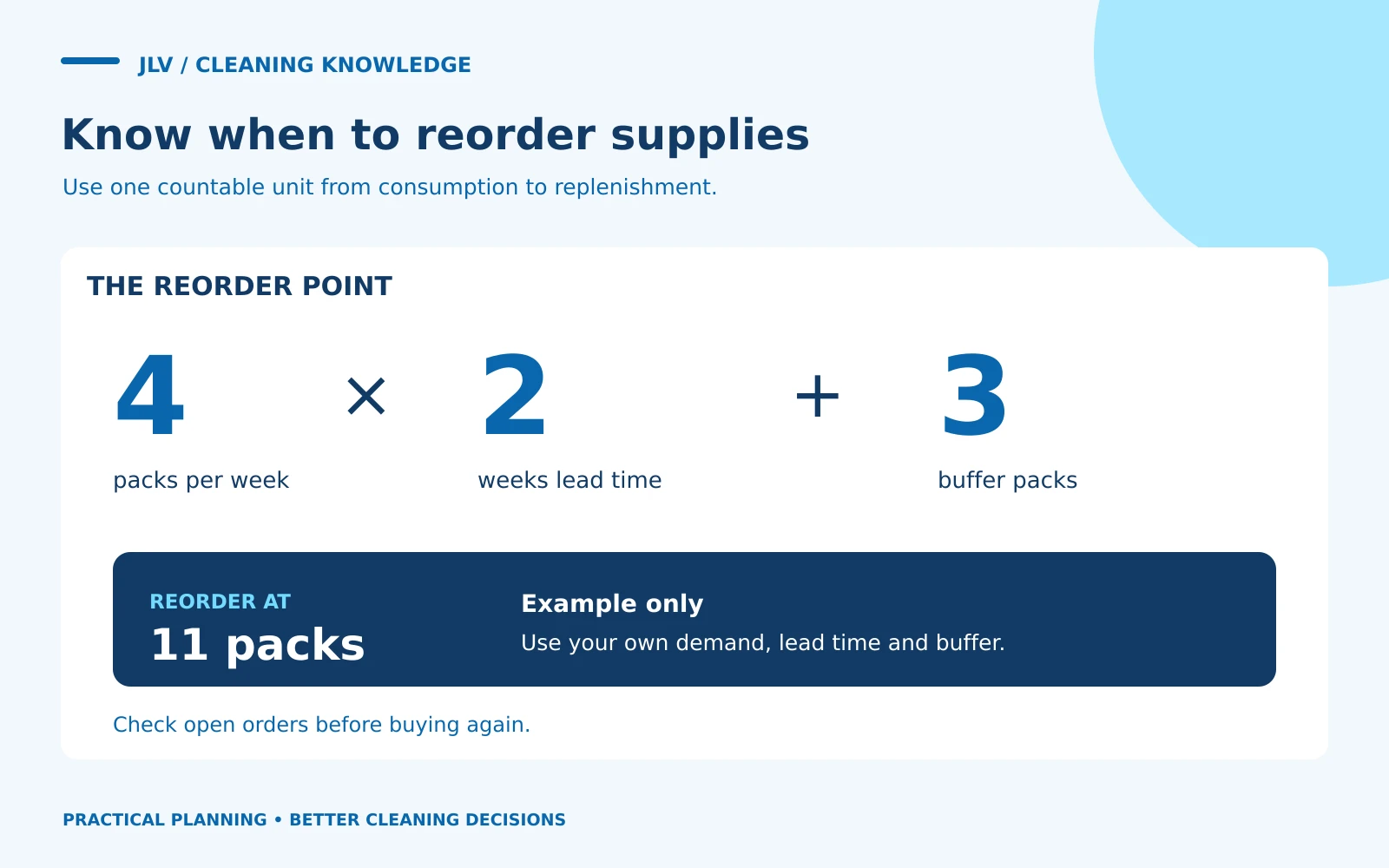
Set a cleaning-supply reorder point by adding expected consumption during replenishment lead time to a chosen buffer. Use the units you actually count, such as rolls, cases, or sealed bottles, and assign one person to act when available stock reaches the threshold.
The calculation is simple. The harder part is measuring comparable consumption and knowing how long an order really takes to become usable stock. A delivery sitting in a locked receiving room has not yet solved a shortage in the supply closet.
Choose the supplies this process covers
Start with a small list of frequently replenished items. Identify who owns each supply: the tenant, building manager, or cleaning provider. Confirm who buys it, who counts it, and whether replenishment is already included in an agreement.
Record the exact product or compatible dispenser specification. Similar-looking paper rolls and cartridges may not fit the installed equipment. For cleaning chemicals, substitutions need a separate compatibility and safety review rather than an automatic purchase based on price or color.
Use one countable unit throughout the record. If the supplier sells a case containing twelve packs, show both the case quantity and the pack count. Do not compare weekly usage measured in individual items with an order quantity expressed in cases without conversion.
Build a short consumption record
At a consistent interval, record opening stock, receipts, and closing stock. Investigate unusual changes before using them as the baseline. A large event, a newly occupied floor, or stock moved to another closet can make consumption appear different from ordinary use.
Count usable stock separately from damaged, expired where applicable, reserved, or incompatible items. Note outstanding orders so the buyer does not reorder the same shortage twice. Keep employee names and individual usage out of the log; this is a supply-planning record, not a staff monitoring tool.
Work through an example
Assume an office uses four packs of a particular paper product each week. The supplier normally needs two weeks from order approval to receipt, and the office chooses a three-pack buffer. Expected lead-time demand is eight packs. Adding the buffer creates an eleven-pack reorder point.
That is a fictional arithmetic example, not a recommended stock level for every office. If deliveries slow down or attendance rises, the threshold needs review. The order quantity is a separate decision based on storage capacity, purchasing rules, and expected demand after replenishment.
If available stock is ten packs and a twelve-pack order is already confirmed, check that order’s arrival date before placing another. If no order exists, the threshold tells the assigned buyer to act.
A usable inventory card
- Item name and approved specification
- Countable unit and supplier pack size
- Normal usage and measurement period
- Observed replenishment lead time
- Chosen buffer and reason
- Reorder point and usual order quantity
- Current usable stock and open orders
- Person responsible and next review date
For chemicals, keep safe storage limits and product instructions ahead of bulk-buying convenience. OSHA and NIOSH guidance addresses labeling, handling, storage, and worker training. Never mix leftover chemicals to consolidate inventory or decant them into unidentified containers.
Adjust the rule when conditions change
Review the record after a move, attendance change, supplier delay, or dispenser replacement. A buffer should have a reason and a storage location; it should not expand indefinitely. Share the approved supply list and shortage-reporting process with the cleaning provider so a low-stock observation reaches the person who can purchase replacements.