
Office cleaning
How to clean an office while employees are still working
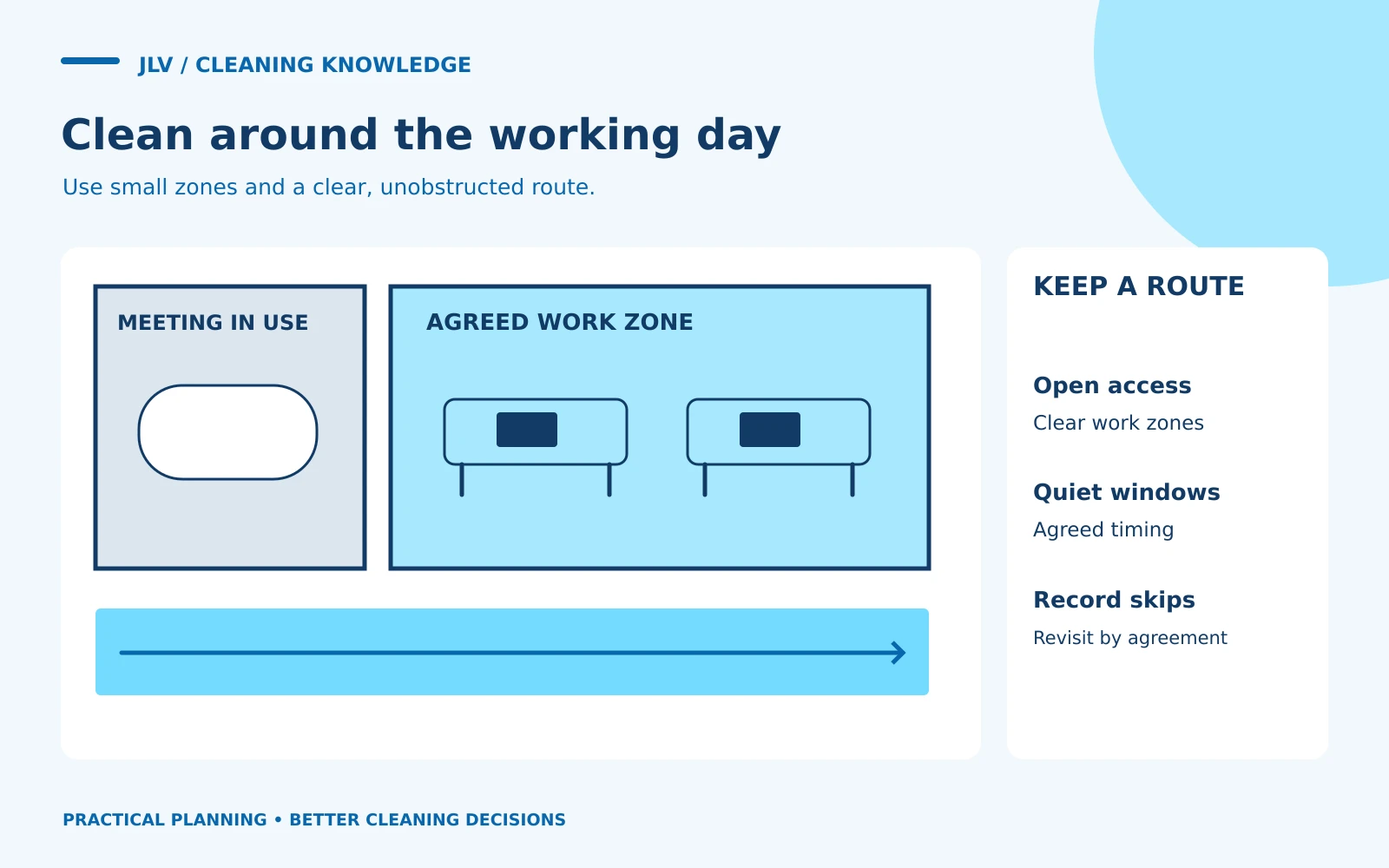
Clean an occupied office by agreeing on small work zones, access windows, and interruption rules before the visit. Give employees a clear way to pause or redirect work when a meeting, sensitive task, or access need conflicts with the plan. Do not promise that daytime cleaning will create no disruption.
The goal is to complete useful work while people can continue using the office safely. Some tasks may need a different time or an empty area. Make those decisions before equipment or wet work creates a conflict.
Divide the office by activity
Identify active workstations, meeting rooms, visitor areas, restrooms, and routes that must remain available. Ask which rooms have quiet periods or brief vacancies. Use those windows to create a sequence rather than sending the crew through every area in a fixed order regardless of occupancy.
Choose an office contact who can confirm access without interrupting every employee. The provider should know when to skip an area, when to ask the contact, and when a deferred task needs a separate visit. A skipped occupied desk should be recorded accurately rather than treated as completed.
Give staff useful notice
A practical notice states the date, approximate work window, affected rooms, and what employees should clear. Avoid publishing worker phone numbers, building credentials, or employee health details. Where an accommodation is needed, communicate the approved operational restriction through the appropriate private process.
For example: “The east meeting room is available for cleaning after its scheduled meeting. Please remove personal items from the table and keep the west corridor available.” This is an illustrative message; the office should adapt it to the actual plan.
Protect routes and respect surfaces
Keep an agreed route open while another area is being serviced. OSHA’s general walking-surface requirements address safe access and hazardous surface conditions. Signs alone should not be treated as permission to leave people with no safe way through.
Discuss noisy equipment and tasks requiring a temporarily unavailable surface. Staff should not step through a work zone because the schedule leaves no practical alternative. If the office cannot provide a suitable window, change the sequence or arrange the task for another time.
Use products within their instructions
Occupied work does not justify weaker labeling, improvised dilution, or a product selected only for its smell. OSHA and NIOSH guidance addresses ventilation and appropriate worker protection. Product instructions and site conditions should guide whether a task can proceed while people remain nearby.
Tell the provider about approved product restrictions without making medical claims. Fragrance preferences and health accommodations should be handled carefully; no generic product description guarantees that a substance will be suitable for every person.
Occupied-office checklist
- Zone sequence and quiet windows agreed
- Office contact available
- Employee notice sent through the office’s channel
- Safe circulation route maintained
- Personal items and confidential papers secured by their owners
- Equipment and product restrictions identified
- Rules for skipped rooms established
- Deferred work recorded for a decision
Cleaning staff should not open drawers, turn over documents, or use computers to clear a work area. FTC guidance supports limiting access to information that is genuinely needed.
Review interruptions after the visit
Ask which conflicts repeated. A regularly occupied meeting room may need a reserved cleaning window; a workstation cluster may need an after-hours task. Update the plan using those observations rather than asking staff and cleaners to negotiate the same obstacle every day.