
Office cleaning
How to arrange bulky-item removal without adding it to routine cleaning
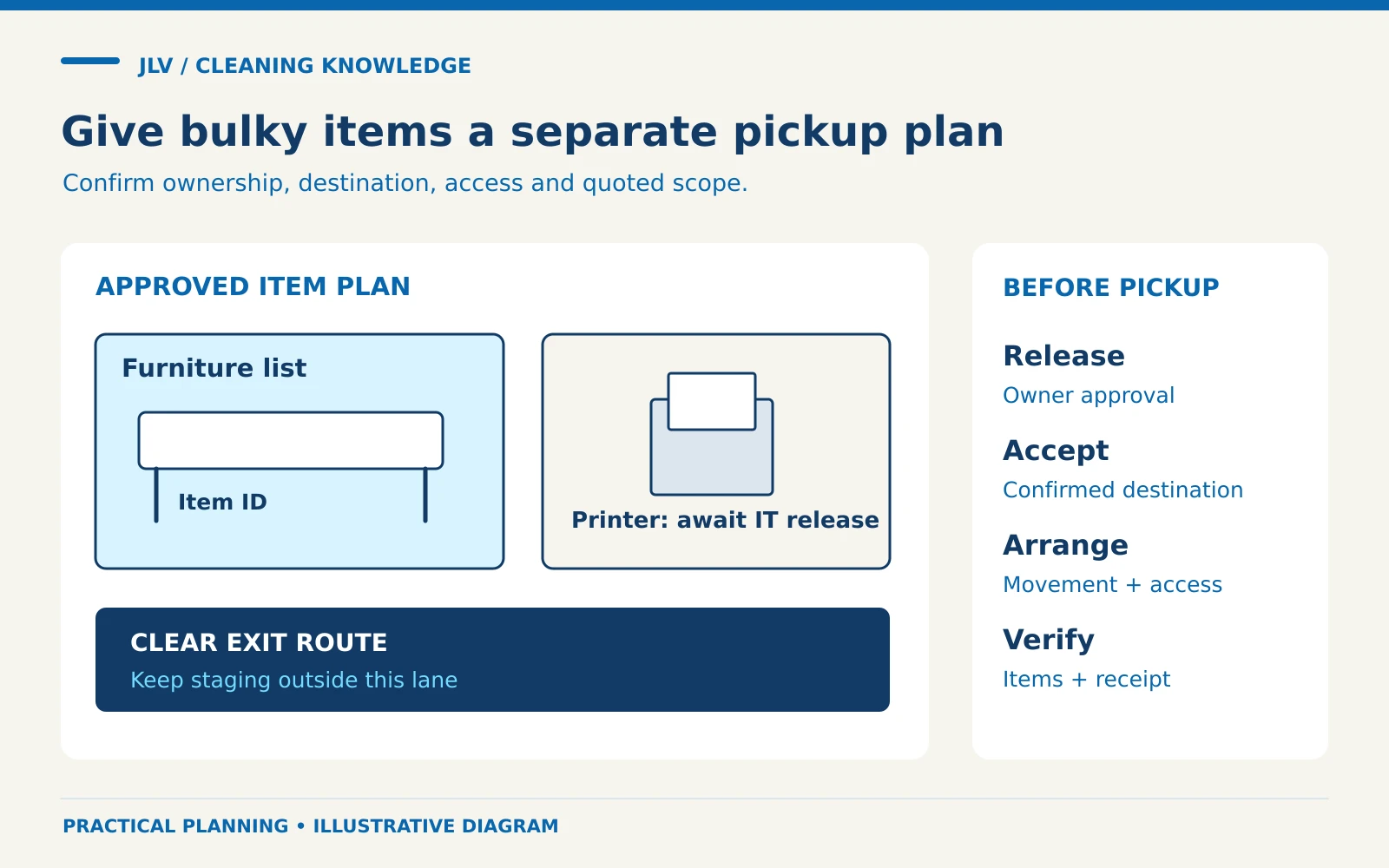
Arrange bulky-item removal as a separate task with an approved item list, destination, access plan, and price. An unwanted desk beside the waste bins can still belong to a tenant, be leased, or require a collection service that the building has not booked.
Routine cleaning may cover ordinary waste collection while excluding furniture movement, dismantling, electronic-waste handling, or hauling. Check the written scope and obtain separate confirmation for any extra work. Do not assume a cleaning provider offers these services.
Confirm ownership before scheduling removal
Give each item an identifier and photograph it where permitted. Record its location, owner, condition, and approximate dimensions. Ask the authorized owner whether it is approved for reuse, donation, recycling, return to a lessor, or disposal.
Check for asset tags and lease or warranty-return arrangements. For computers, printers, and other data-bearing equipment, have the organization’s IT or information-security owner authorize release after its required data-handling process. A “broken” label does not settle ownership or information-security requirements.
If permission is missing, leave the item out of the pickup list and assign someone to resolve it. Avoid vague instructions such as “take everything in the storage room.”
Choose a destination the recipient accepts
For reusable items, ask the intended recipient whether it accepts the actual condition, quantity, dimensions, and pickup arrangements. Do not schedule a donation based only on a general mission statement or an old acceptance list.
For disposal, obtain the current commercial rules from the site’s hauler or local waste agency. Residential bulky-item entitlements may not apply to an office account. For example, Fountain Valley lists commercial bulky-item collection as a per-item-fee service, separately from its residential allowance. Ask the current hauler to confirm your account eligibility, accepted items and total price. Other cities may have different arrangements. Fountain Valley bulky-item guidance.
Ask how electronics, appliances, batteries, lamps, and other special items must be handled. CalRecycle lists several such materials as unsuitable for ordinary waste bins and provides electronic-waste resources. Confirm that the chosen collector accepts business-generated items. CalRecycle waste guidance and electronic-waste resources.
Verify movement and collection scope
Send the mover or hauler an accurate item list and access description. Include stairs, elevator limits, loading arrangements, parking restrictions, narrow turns, and whether disassembly is needed. Ask who supplies the appropriate people and equipment. Do not convert a weight estimate into a promise that ordinary cleaning staff can lift the item.
Have building management approve the route, staging area, service-elevator booking, and any protection requirements. Keep exit routes free of stored items; OSHA prohibits placing materials or equipment in an exit route, even temporarily. OSHA exit-route maintenance.
Agree when items may be set out. Avoid leaving them at the curb or beside a dumpster before the hauler confirms both location and collection window.
Complete a disposal request
Use these fields before approving the booking:
- Item identifiers, quantities, photographs, and dimensions: ____
- Owner and written release approval: ____
- Reuse, donation, return, recycling, or disposal destination: ____
- Special-waste or data-security review completed by: ____
- Recipient or hauler acceptance confirmed on: ____
- Movement, disassembly, loading, and collection included: ____
- Total quoted price, exclusions, and cancellation terms: ____
- Building access approval and pickup window: ____
- Person checking the completed pickup and receipt: ____
For example, a tenant replacing six desks and two printers should list the desks separately from the printers. Furniture acceptance does not confirm electronic-waste acceptance, and the printers may need IT clearance before either item group is released.
Stop if the approved plan changes
Pause removal if the crew finds an unlisted item, unknown ownership, leaking contents, a damaged battery, suspected hazardous material, or a route that cannot accommodate the load. Contact the owner and approved provider for revised instructions. Do not dismantle unfamiliar equipment or remove hazardous components to make a rejected item fit the booking.
After pickup, check the identifiers against what actually left, record anything rejected, and retain the appropriate collection or donation documentation. Arrange any ordinary cleaning of the vacated area under its agreed scope. Close the request when the approved items have reached their confirmed handoff and every remaining item has a named next step.
For the ordinary cleaning responsibilities that remain before and after this task, use the office responsibility checklist. Include the confirmed business-cleaning areas and access limitations when requesting a JLV quote.