
Space and astrophysics
Galileo Looks at Jupiter, Then Looks Again
Historical event:
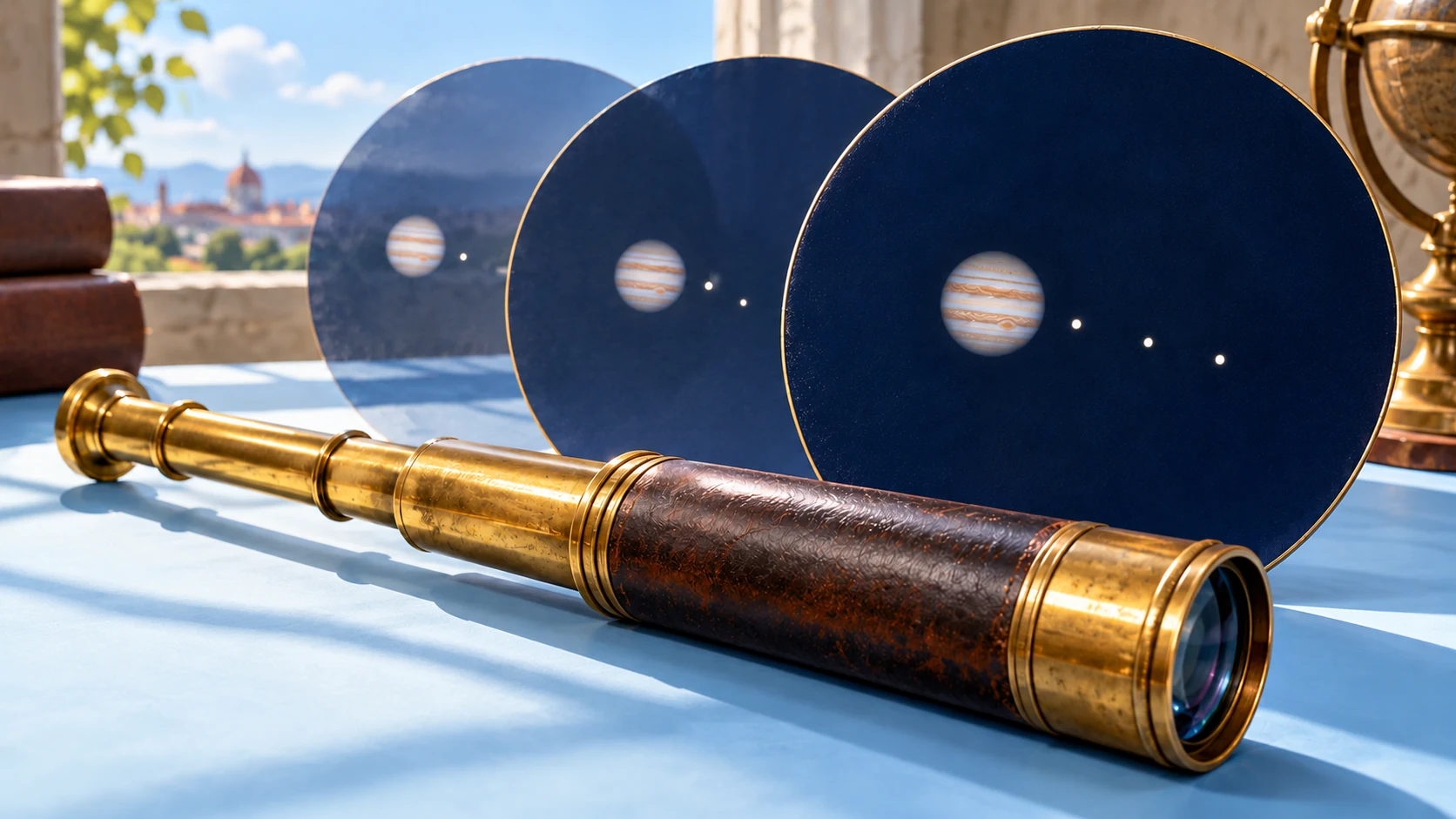
Three little points beside a bright planet could be easy to file away as an interesting view. Galileo looked again, and the points had moved.
On January 7 in 1610, Galileo Galilei observed Jupiter through his telescope and recorded three nearby points of light. At first, he took them to be stars. The first night's view did not present four clearly separated moons with convenient labels attached.
In the account of his observations reproduced by NASA's Jet Propulsion Laboratory, Galileo described returning on January 8 and finding the points arranged differently. They were all to the west of Jupiter, closer together than they had been before. The apparently simple scene had become a problem worth following.
A discovery spread across nights
NASA's historical account describes the changing positions over subsequent observations. The points stayed near Jupiter while shifting relative to one another. Eventually four were recognized, and Galileo concluded that they were moons orbiting the planet.
The significance came from the pattern. Something could circle a body other than Earth. The observations challenged the idea that every celestial object must travel around our planet, while giving astronomers a new system to investigate in its own right.
That is why compressing the story into one miraculous glance loses so much. The first observation supplied a question. Later observations changed the interpretation. The same general patch of sky contained more meaning when viewed as a sequence.
Galileo's account also invited other astronomers to examine the objects and determine their orbital periods. A discovery could become the beginning of work shared by other observers, with more to measure after the initial insight.
There is something wonderfully modest about the physical appearance of the evidence. The moons were points of light, not the richly detailed worlds spacecraft would reveal much later. Their motion made them informative. Careful attention turned a small visual puzzle into a consequential astronomical argument.
For an everyday observer, that may be the most relatable part of the story. You do not always understand what you have seen the first time you see it. Taking a second look can be an active step toward clarity.
Give the finish a second look
In a workplace, save a few minutes to look again after cleaning and after surfaces have dried as their care instructions require. Use the lighting people normally work under. Walk the route they will take when the room is back in use.
The second look gives small observations somewhere to go. Perhaps an ordinary smudge remains, or a mark needs to be compared with a condition noted before the work. Record a specific question instead of assuming every visible mark calls for a stronger treatment.
For the owner, this is a chance to notice the room as a whole before the next busy day takes over. The useful detail is often the one you passed without seeing the first time.
Keep your eye on the finish. Talk with JLV about office cleaning in Orange County and the details you want brought into view. Sometimes the useful discovery comes on the second look.