
Bathroom cleaning
How to Clean a Bathroom Exhaust Fan Cover
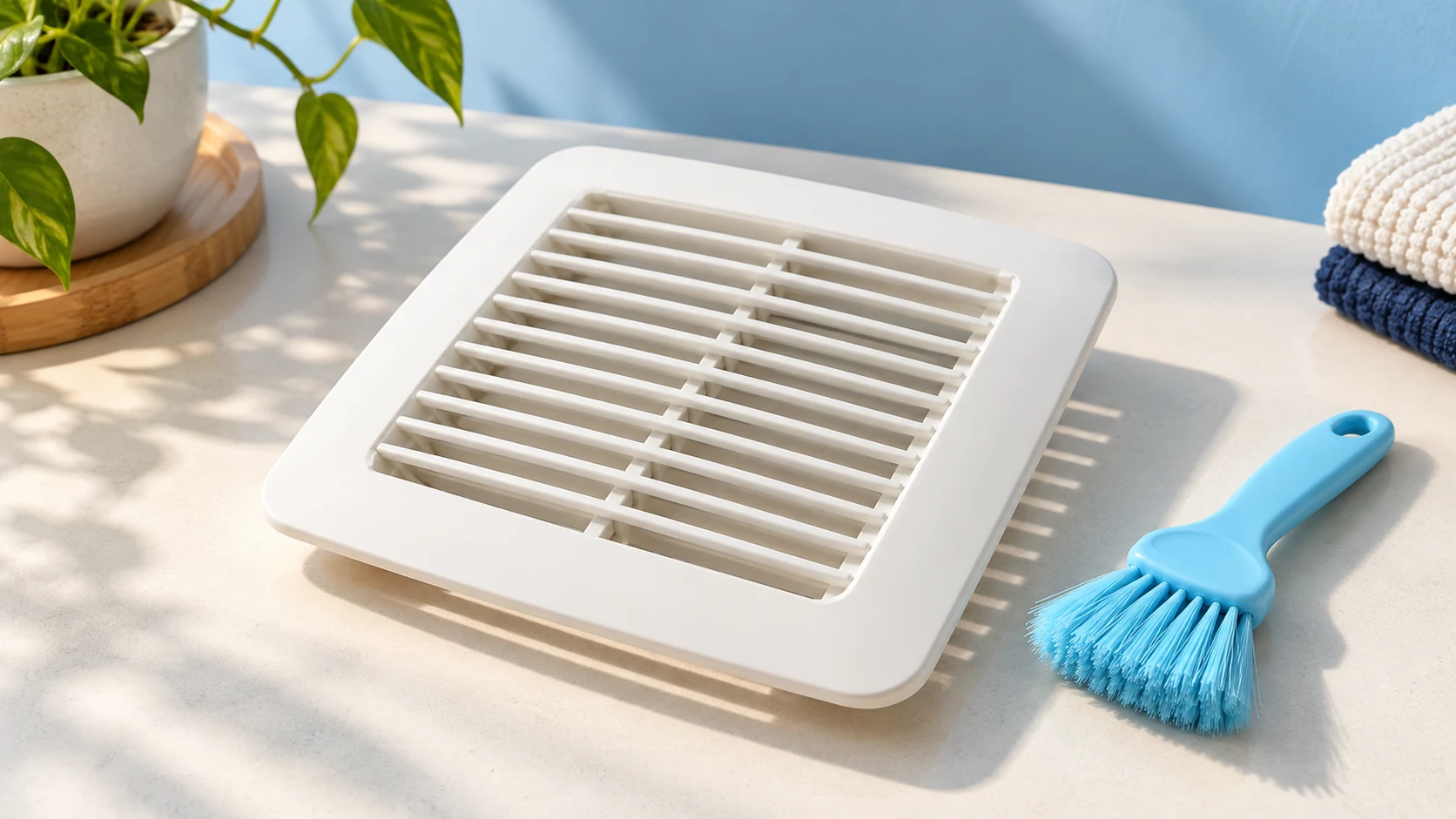
Clean an accessible bathroom exhaust-fan cover only after isolating power as the exact manual requires. Remove ordinary dust with a soft brush or vacuum attachment. Treat a cover containing lights, sensors or speakers as an electrical assembly, not as a plastic piece to soak in a sink.
Identify the fan before touching the grille
Find the model in building records or the manufacturer’s documentation. Cover-release methods vary, and some grilles have electrical connections. Do not pull harder when a cover does not release as expected. Obtain the correct instructions or ask a qualified person to handle it.
This guide covers an accessible cover with ordinary household dust. It does not cover wiring, motor replacement, attic or roof access, duct cleaning, mold contamination or renovation debris. Crumbling ceiling material and unidentified old coatings should be assessed before disturbance.
Prepare safe access
- The exact fan manual and its power-isolation instructions
- A stable stepladder suitable for the location, never the toilet, bath rim or a chair
- A vacuum with a soft dusting brush and clean dry cloths
- Eye protection and gloves where the manual calls for them; sharp grille edges need care
Clean the cover in order
1. Make the area dry and clear. Move toiletries out of the fall zone and prevent anyone from operating the fan during the work. If reaching the grille requires an unsafe stretch, stop and get help with suitable access equipment.
2. Isolate electrical power at the service panel as instructed and prevent accidental reconnection. Broan-NuTone manuals call for locking the disconnect or using a prominent warning tag when it cannot be locked. A timer or wall switch alone may not provide the required isolation.
3. Follow the model’s method to lower or remove the cover. Support it so it does not hang from wiring or fall. If electrical connections, unexpected resistance or unfamiliar parts prevent safe removal, leave further work to a qualified person.
4. Lift ordinary dust from the cover with a soft vacuum brush or dry cloth. Work along the grille openings rather than forcing a tool through them. Do not blow dust into the room with compressed air.
5. Wash a detached, entirely non-electrical cover only if its manual permits washing. Otherwise keep to approved dry cleaning. Broan’s humidity-sensing fan instructions specifically prohibit sprays, solvents and water near the sensor. The presence of plastic does not prove a part is washable.
6. Ensure all permitted washable parts are fully dry, then reinstall according to the manual. Remove tools, step down and restore power only when the assembly is secure and the work area is clear. Check normal operation without reaching into the running unit.
Stop for signs of a fault
Burning smells, sparks, unusual noise, damaged wiring or a fan that will not operate require service. Turn it off and contact the responsible maintenance person or electrician. Do not oil a motor, adjust a sensor or change wiring as an improvised cleaning fix.
Dust removal also does not prove the duct is clear or the fan has enough airflow. If the bathroom stays damp after the cover is clean, ask for a ventilation assessment rather than repeatedly washing the grille.
Keep a useful record
Save the model number and manual, and check the cover when ordinary dust becomes visible. For routine business and office cleaning in Orange County, Chino and Ontario, California, discuss accessible cleaning scope with JLV at /contact/. Electrical and ventilation faults belong with qualified trades.