
Science
ENIAC and the Computer You Could Walk Around
Historical event:
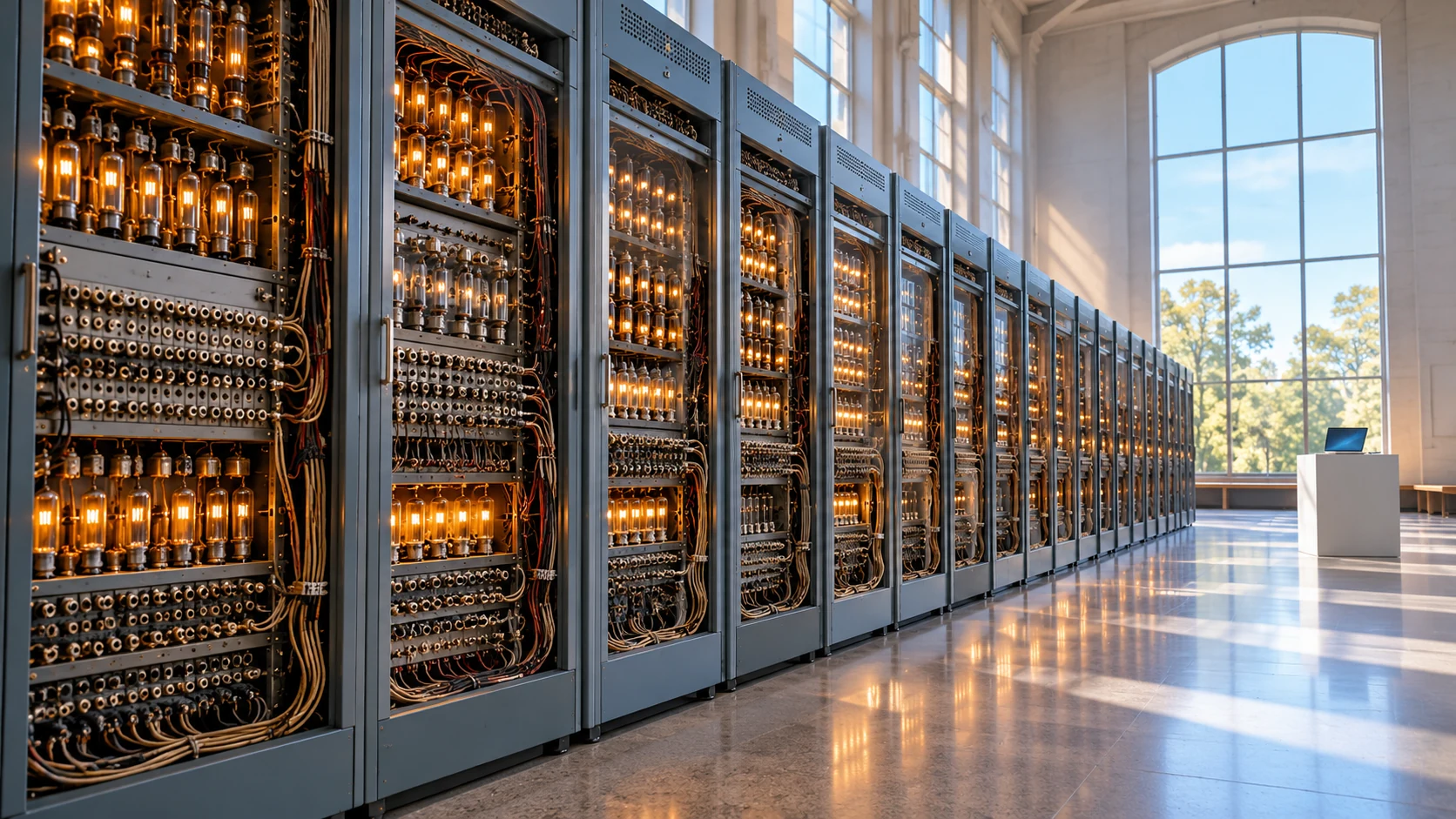
Today, a computer can disappear into a bag. ENIAC asked you to think in room dimensions.
On February 15 in 1946, ENIAC was formally dedicated at the University of Pennsylvania. The Army's historical chronology describes a ceremony in Houston Hall followed by a visit to the Moore School for a demonstration. The celebration was one event in a sequence of tests, press activity, and public introductions.
Penn's later account pictured the original machine's roughly 18,000 vacuum tubes occupying a room about 30 by 50 feet. That is a useful image to hold: computing power presented as equipment surrounding people, rather than a small object waiting on a desk.
ENIAC stood for Electronic Numerical Integrator and Computer. Developed under an Army project, it was intended to accelerate demanding calculations. John Mauchly and J. Presper Eckert were central figures in its design and engineering, working with a wider team at Penn's Moore School.
The equipment is visually dramatic, but the people who made it useful deserve equal space in the picture. Six women programmed ENIAC, translating mathematical problems into operations the machine could carry out. The ENIAC Programmers Project recorded oral histories with Kathleen McNulty Mauchly, Jean Jennings Bartik, Marlyn Wescoff Meltzer, and Betty Snyder Holberton. Its account describes learning without programming languages or ready-made manuals.
That is an extraordinary assignment. Imagine being asked to explain a problem to a machine whose working language you must help establish. The physical scale of the equipment was only part of the challenge. Someone still had to decide how to make the calculation happen.
Penn's history also cautions against treating ENIAC as the beginning of every kind of computing. Earlier mechanical and electronic projects had explored different pieces of the problem. ENIAC's significance becomes clearer when it sits within that continuing work, with its particular capabilities and limitations described carefully.
The room-sized machine makes an abstract idea tangible. Information technology has always depended on places, equipment, and knowledgeable people. Shrinking the hardware can make those dependencies less visible, but it does not erase the need to know who is responsible for what.
Draw the line before the equipment room
A modern office may fit far more computing into far less room, but it still helps to know where the everyday workspace ends and IT-managed equipment begins. Ask your technology contact to identify restricted rooms, equipment that stays untouched, and the ordinary surfaces ready for cleaning.
Make that distinction easy to recognize on site. An open door or a familiar-looking cabinet cannot explain what a business depends on. A brief note from the right person can spare everyone a round of guesswork.
JLV offers office cleaning in Ontario. Tell us about the everyday spaces around your technology, and let's give your team room to keep the ideas moving. The computer can handle the calculations.