
Hiring & service planning
Does Your Office Need a Deep Clean Before Regular Service?
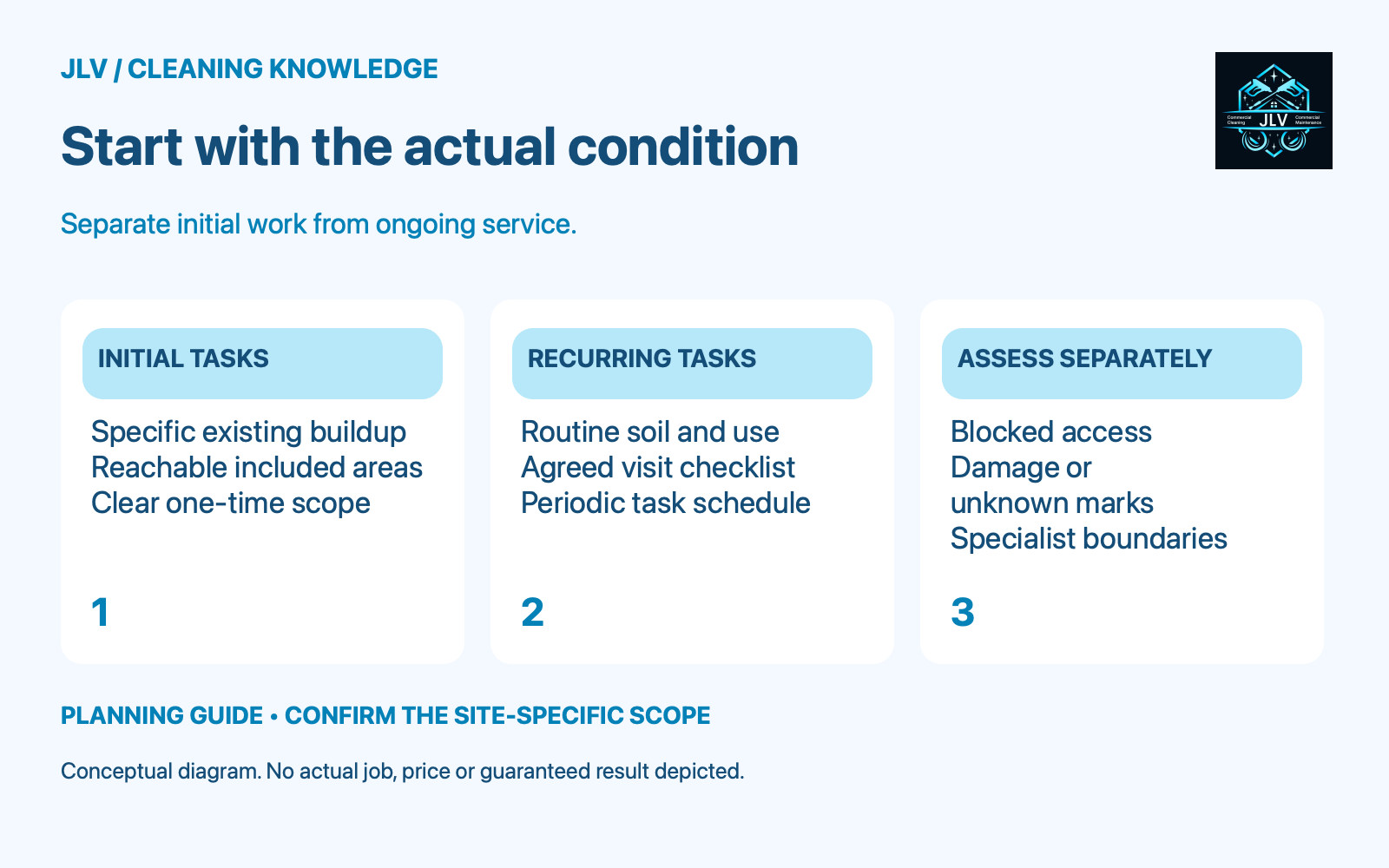
An office may need an initial detail clean when existing buildup requires work beyond the proposed recurring checklist. That does not make a deep clean a required first step for every office. Ask the provider to identify the actual tasks, why they are needed now and which will remain part of ongoing service.
Treat the phrase deep clean as a prompt for a scope discussion. It does not tell you which rooms, surfaces, methods or exclusions are included. A useful proposal separates the one-time starting work from the visits that follow.
Sort what you see into four groups
- Recurring soil: ordinary debris or fingerprints expected to return with regular use.
- Existing buildup: specific reachable areas that may need additional initial attention.
- Access limitations: surfaces blocked by boxes, furniture, documents or locked doors.
- Damage or an unknown condition: worn finishes, scratches, unexplained staining or residue needing assessment.
Walk the space with the proposed recurring task list. Record a location and observable condition rather than guessing its cause. For example, “visible dust on the accessible baseboard behind the meeting table” is more useful than “the whole room needs restoration.”
A provider can discuss whether an identified cleaning task is feasible. Neither a walkthrough nor the phrase deep clean establishes that a worn finish, permanent discoloration or damaged surface can be restored.
Ask what changes on the initial visit
For every proposed initial task, ask what makes it different from routine work: the area included, the material, the amount of buildup or the method being considered. Ask whether the work can be completed within the available access window and what your team must clear first.
- Exact area and surface to be cleaned.
- Observed condition and any known material-care instructions.
- Proposed one-time task and its limitations.
- Preparation, access and furniture-moving responsibilities.
- Separate price or clearly identified inclusion in the proposal.
- How the result and remaining exceptions will be recorded.
If the explanation is only that all new customers receive the same package, ask for the scope that applies to your office. You can evaluate a provider's commercial terms while still requiring a clear description of the work.
Build two lists instead of one oversized promise
Use one list for the initial visit and another for recurring visits. A hypothetical office might need extra attention to reachable door frames and baseboards at the start, while its regular schedule covers agreed restrooms, shared surfaces, waste and floors. The example is a planning illustration, not a JLV package.
Give each initial item a future destination: added to the routine checklist, placed on a periodic schedule or completed as a one-time task. Without that decision, the same area can be overlooked again even after a successful first visit.
Some offices can begin with the recurring scope and add a small number of separately approved detail tasks. Others may need a distinct initial visit. Ask the provider which approach is feasible for the actual condition and access; do not assume more visits or a stronger product is always the answer.
Keep disinfection and specialist work explicit
CDC guidance distinguishes cleaning from disinfection. A more detailed cleaning visit does not by itself establish that disinfection was performed. When disinfection is part of an agreed ordinary-office scope, specify the surfaces and an appropriate product used according to its directions. Healthcare and other specialized facilities can have different requirements.
Ask separately about carpet extraction, floor-finish work, high-access areas or unfamiliar residues. Naming a deep clean does not include those services or establish that a provider offers them. Surface-care instructions and the actual written proposal should determine the boundary.
If the office still has construction dust, paint residue or incomplete installation work, describe that before requesting a routine-service quote. Use a post-construction scope discussion where appropriate. Unknown or suspected hazardous material needs the responsible qualified assessment before affected cleaning proceeds.
Review the result against the starting record
Agree on a short walkthrough after the initial work and before normal use changes the areas being reviewed. Check the included surfaces and note any remaining access restrictions or conditions outside the scope. Keep existing damage in a separate record rather than converting it into a promise of further cleaning.
Then review the recurring schedule after the office returns to normal use. If an entrance gets dirty between visits, that is a frequency or workday-coverage question. It does not necessarily mean the initial detail work failed.
Send a useful initial-cleaning inquiry
Tell JLV the city, occupied area, room types, current service arrangement and the specific buildup you have noticed. Include any recent move or renovation and the areas your team can clear. Ask for initial tasks and recurring tasks to be described separately, with prices, exclusions and access needs confirmed before booking.
JLV discusses business and office cleaning in Orange County, Chino Hills, Chino, Ontario, Corona and Eastvale. A quote request starts the scope conversation; it does not reserve a date or guarantee that a particular mark can be removed.