
Human origins
Lomekwi’s Stones Asked an Older Question
Historical event:
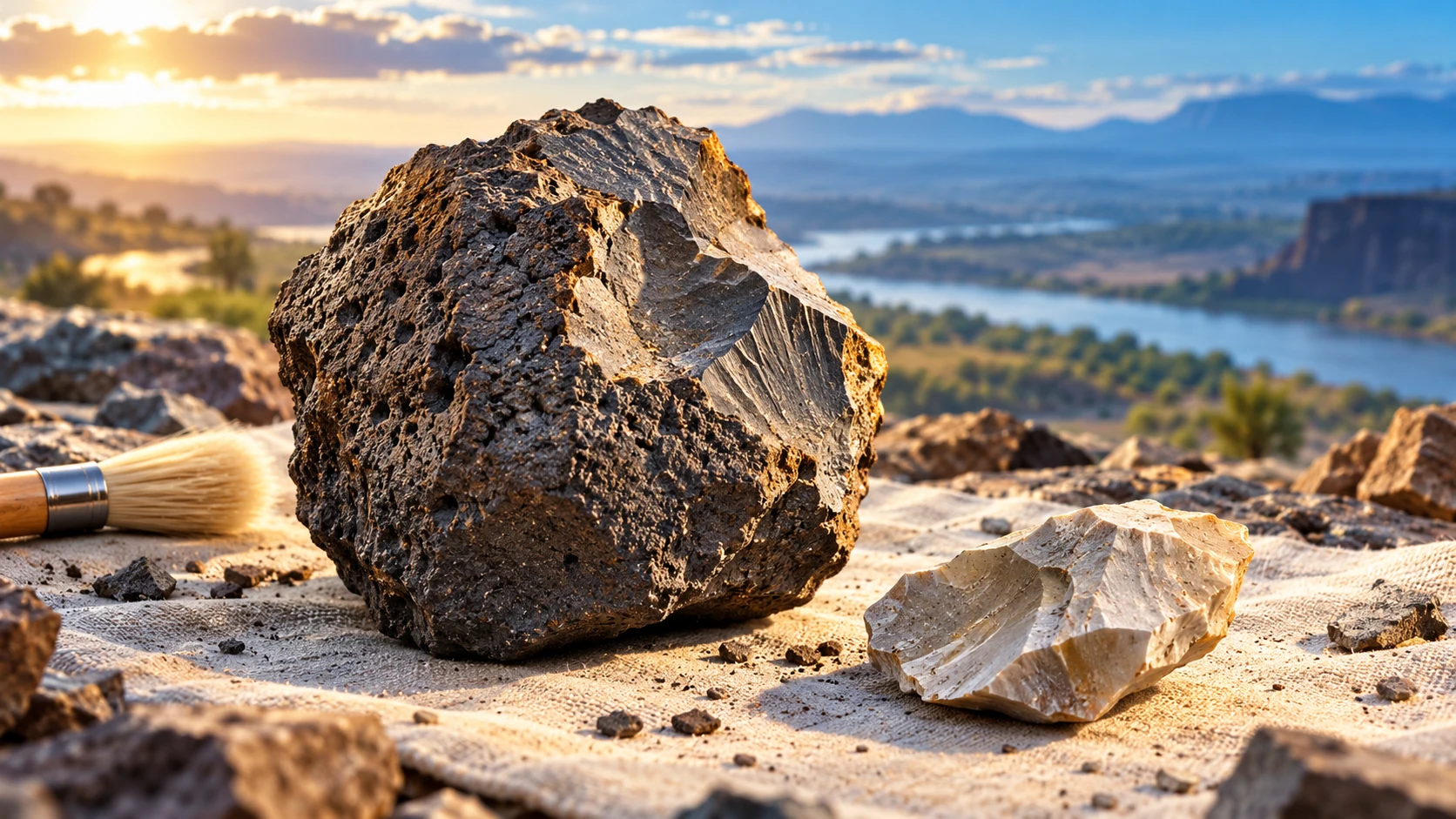
A broken stone is not automatically a tool. For archaeologists, the interesting question is how it broke, where it was found, and whether several kinds of evidence point to deliberate work.
On May 20, 2015, Nature published the online report of stone artifacts from Lomekwi 3 in West Turkana, Kenya. The journal issue was dated May 21. Sonia Harmand and colleagues described a site dated to about 3.3 million years ago, extending the discussion of stone technology far beyond the familiar image of our own species making tools.
The reported collection included large cores, flakes, and stones associated with pounding. Researchers examined the physical traces and conducted replication experiments to understand how pieces could have been produced. The surrounding sediments and geological context were essential to establishing when the activity took place.
The ground is part of the evidence
A tool displayed by itself can look like the whole discovery. In field research, its position matters. Was it found within a sediment layer, or loose on the surface? How does that layer relate to the rest of the site? Can the proposed history account for both the object and its surroundings?
The Lomekwi paper distinguishes excavated material from surface finds and documents the site’s stratigraphy. The finding was therefore more than a set of interesting shapes. It was an argument supported by artifacts, context, and comparison.
The authors proposed the term Lomekwian for the assemblage. They also left a major question open: which hominin species made it? A technological trace does not come with its maker’s name. Assigning it confidently to a species would require evidence beyond the fact that ancient relatives lived in the wider region.
A 2025 review coauthored by Harmand places the Lomekwian and early Oldowan within the first million years of known stone technology. It considers multiple possible toolmaking hominins and comparisons with nonhuman primates. That broader picture keeps the story from turning into a simple ladder on which one species suddenly acquires all the interesting abilities.
What makes the stones compelling is the chance to investigate an action across immense time. Someone struck, handled, or used material, and traces remained. The careful work is in deciding which interpretation those traces can actually support.
Read a mark before assigning a task
In a newly renovated workplace, a visible mark also deserves a description before a response. It could be residue, a scratch, an intentional texture, or an unfinished detail. Those possibilities belong to different conversations.
Document an uncertain area with permission and ask the owner or responsible contractor what it is. Establish the material and the appropriate guidance before treating removal as routine cleaning. Looking closely is a useful first step; escalating a method on a guess is not.
Renovating a business in Orange County, Chino, or Ontario? Tell JLV which finishes and unresolved marks need discussion before post-construction cleaning. Let’s understand the surface before writing the next chapter on it.
Sources
- 3.3-million-year-old stone tools from Lomekwi 3 — Harmand et al., Nature
- Lomekwi 3 paper, author-institution copy — Rutgers University
- The First Million Years of Technology: The Lomekwian and the Early Oldowan — Plummer et al., 2025
- Stony Brook Scientists Discover Oldest Stone Tools on Record — Stony Brook University