
Human origins
Homo floresiensis Is Described and Size Becomes a Bigger Question
Historical event:
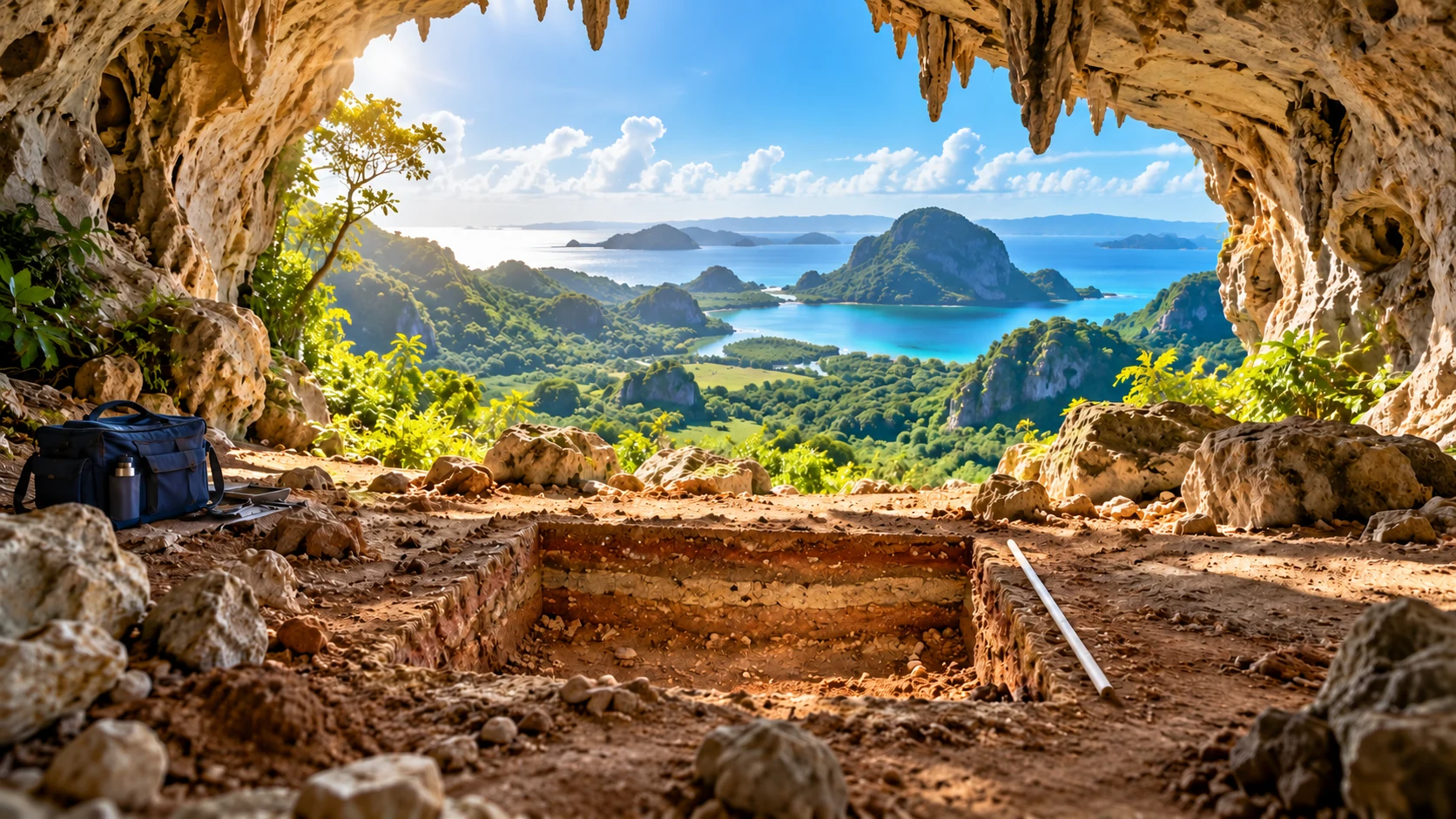
The skeleton was small enough to challenge an assumption before the full argument had even begun. In the October 28, 2004, issue of Nature, Peter Brown and colleagues described Homo floresiensis, a newly named human species from the Indonesian island of Flores.
The central specimen, LB1, had been recovered in September 2003 at Liang Bua, a limestone cave. The original paper identified an adult from evidence including tooth development and skeletal maturity. The finding challenged the easy assumption that a small skeleton must belong to a child.
The specimen demanded an explanation that took its adult anatomy seriously.
The authors considered a combination of features across the skull, jaw, and body. That combination supported their proposal of a distinct species. A single measurement drew attention, but the classification required looking at the whole available picture.
The Smithsonian's current account recognizes H. floresiensis as a species distinct from modern humans while keeping questions about its ancestry open. Did its small stature develop through island evolution, or did it descend from ancestors that were already small? The shape of the family tree still deserves investigation.
Revising the frame
Dating has also changed as work continued. The Smithsonian summarizes the known Liang Bua bones at roughly 100,000 to 60,000 years old, with associated stone-tool evidence extending later. Those ranges supersede the much younger dates attached to the discovery in early reporting. An old headline can remain memorable after its numbers need updating.
This is part of what makes the story worth revisiting. Excavation, anatomical comparison, and the study of the cave's deposits kept adding context to the initial discovery. The interpretation had to stay responsive to that work.
Body size does not provide a shortcut to someone's intelligence or to a ranking of human worth. The scientific interest lies in diversity and evolutionary history. H. floresiensis expands the questions we can ask about the human past rather than occupying a convenient rung on a ladder.
A smaller everyday observation follows from the habit of looking beyond one measurement. An office's floor area tells you its size. It does not, by itself, describe the cleaning assignment.
A compact room may hold dense furnishings, several kinds of finish, equipment that must stay in place, and awkward gaps between objects. Before assuming a small workplace will be a simple job, walk its actual layout and identify the accessible surfaces. Note what occupants will move and what the agreed scope includes.
That gives a business owner a more useful starting point than a square-foot number alone. The room can be understood as it is used.
Show JLV the real arrangement of your Chino workspace when discussing office cleaning. Let's give even the smallest details proper consideration.