
Pop culture
2001: A Space Odyssey and the Power of a Clean Line
Historical event:
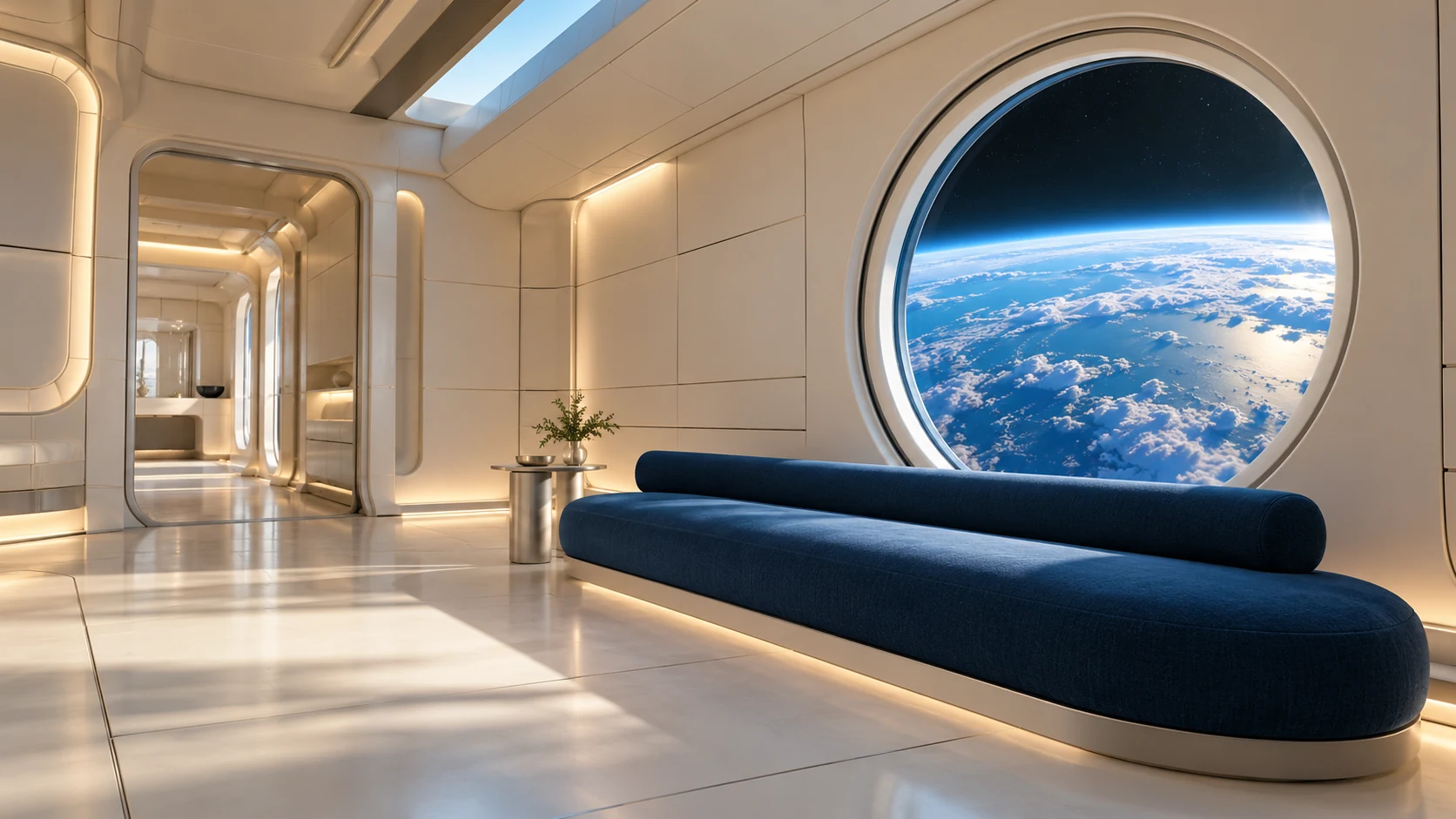
A room can look futuristic before anyone explains what year it is. A curve, a broad white surface, the distance between a person and the furniture: suddenly ordinary interior design starts telling a science-fiction story.
On April 2 in 1968, 2001: A Space Odyssey premiered in Washington, D.C. New York and Los Angeles openings followed on April 3 and 4. Stanley Kubrick's imagined future arrived with extraordinary attention to the spaces people might inhabit beyond Earth.
The American Film Institute credits Tony Masters, Harry Lange, and Ernest Archer as production designers. Naming them is worth the moment. The film's environments did not emerge from an abstract idea of the future. People had to turn drawings, materials, machinery, and staging decisions into places a camera could explore.
AFI's production history records the centrifuge set used for the Discovery spacecraft's interior, built on soundstages at MGM-British Studios in England. The estimated cost was $750,000. Behind the image of a controlled, almost effortless environment was a substantial piece of filmmaking infrastructure.
The Academy's account traces Kubrick and Arthur C. Clarke's collaboration to May 1964, followed by filming beginning in December 1965. Its discussion emphasizes the movie's carefully researched production design and its visual storytelling. The future took years of work before audiences could spend an evening inside it.
One pleasure of those interiors is how strongly their lines organize your attention. A sparse room gives each visible object a larger share of the frame. A seam, a chair, or a change in color can carry unusual weight because the eye has fewer places to wander.
That visual discipline can feel reassuring, unsettling, or both. An immaculate-looking room may offer comfort at one moment and make its occupant seem isolated at another. The same broad surfaces that suggest calm can expose how small a person looks within the space.
This is design doing dramatic work. The rooms are memorable because their shapes participate in the story. Their restraint gives a viewer time to notice a small disturbance, which can feel enormous in a setting where everything else appears carefully composed.
Simple rooms still have details
In a minimalist office, the small details have unusually large roles. A fingerprint on a broad door panel or a dusty floor edge can catch the eye because so little competes with it. Walk through and notice the few surfaces doing most of the visual work.
Bring those priorities to the cleaning conversation, along with the finish the designer intended. Matte, textured, and reflective surfaces each have their own appearance; more shine is not automatically the goal. A short list of the details that matter can be more useful than asking for the whole room to look new.
Let the design have the spotlight. Talk with JLV about office cleaning for your Orange County workspace and the quiet details behind its clean lines. No voyage to Jupiter required.